The First Discourseman
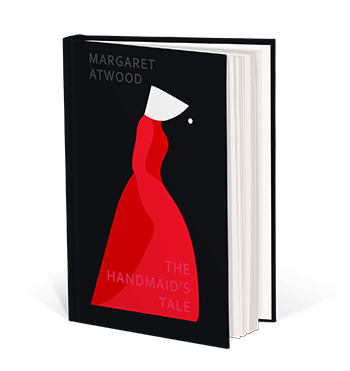
I read The Handmaid’s Tale hoping to be challenged, tentatively expecting to have my patriarchal worldview shattered. At the very least I expected a fast-paced, strange dystopia, of an America simultaneously terrifying and familiar. Alas, I experienced none of these things, and for most of the book I found myself struggling to pay attention to any given sequence of words in front of me. Yet it was a very good book.
I knew very little about Margaret Atwood’s classic before I started, only that it described a dystopian United States established by the crazy fundamentalists, where the subjugation of women was justified through Scripture. In both the US and the UK it has become an esteemed feminist text, studied in schools and read widely, but books good for studying do not always make the best reading.
Throughout the book we see only through the white blinkers of Offred, in a society where women of breeding potential are named after the Commanders with whom they breed. As a result the book feels claustrophobic and restricted- I was constantly wishing the narrator would zoom out and tell us more about the world in which she lived- but I suppose that was the point. For Offred, life consists of the mundane, and there is no grand plan of resistance and escape. Resistance manifests itself in tiny ways: making eye-contact with a guard; playing Scrabble illicitly. We become increasingly aware of an organised resistance movement, but we only ever know as much as Offred does, who can’t do much more than speculate and hope. Chiefly this is shown in the ending, where even she has no idea whether there is an organised resistance ready to rescue her, or she has acquiesced to her own capture.
Offred enjoys words, in much the same way as Atwood herself, which offers a convenient explanation of why her ‘memoirs’ read like a piece of GCSE creative writing. Descriptions are lingering, tortured and focus on the quotidian: one cannot find out that she sits in a chair without also knowing that she
“think[s] about the word chair. It can also mean the leader of a meeting. It can also mean a mode of execution. It is the first syllable in charity. It is the French word for flesh. None of these facts has any connection with the others.”
In any single instance one can appreciate Offred’s vivid, imaginative pen, forced to think and write extraordinary descriptions of the ordinary. But when these descriptions come page after page, until the reader can’t even remember which room Offred is in or what she was doing before she began her soliloquy about a boiled egg, it does become painful.
As a result I struggled to stay motivated to finish the book, despite being increasingly curious about where the book was heading. But perhaps it was the lack of development that made me appreciate it after I’d put it down. Atwood was doing something substantially different to most dystopian authors. The Handmaid’s Tale is a diary, with all the particular insights and limitations that brings. Consequently we never get the privilege of knowing more about Gilead than Offred herself did. Furthermore, it is an eminently realistic dystopia. The protagonist doesn’t, and simply can’t, resist in meaningful ways, despite her personal opposition to the regime. Conversely, we see the remarkable ease by which a radically new and unpopular regime is established.
Ultimately that is what The Handmaid’s Tale is about. It doesn’t have a hidden moral message, or a fantastical creativity to it. It is the expression of Atwood’s fears that an absurd Christianised patriarchy was not implausible, even if her book was a worst-case scenario. In the postscript she draws out multiple historical parallels; Atwood insists that each aspect of Gilead has its historical precedent.
Interestingly, she does not caricature Christianity either. Offred sardonically notes that when Jesus’s words “Blessed are the meek” are quoted, the part where they inherit the earth is conveniently left out. It is a particular manifestation of Christianity that produces Gilead, with some explicitly un-Christian elements (polygamy is allowed, for instance). So whilst it is a critique of fundamentalism, it is all the more effective and poignant for exposing the faithlessness of those in charge.
For the sheer novelty of The Handmaid’s Tale I’d have to commend it, even if it meandered along at an excruciatingly laboured pace. The language was often galling, the myopic perspective was frustrating, and the ending was tantalising. But that was, in a way, the point. There is no great escape, where Offred begins a one-woman revolution, but then that probably wouldn’t happen if Gilead did come to pass. There are just lonely, confused individuals, wondering what had happened and what to do next.
 The Four Discoursemen