The Fourth Discourseman
“Son, you are always with me, and all that is mine is yours. It was fitting to celebrate and be glad, for this your brother was dead, and is alive; he was lost, and is found.”
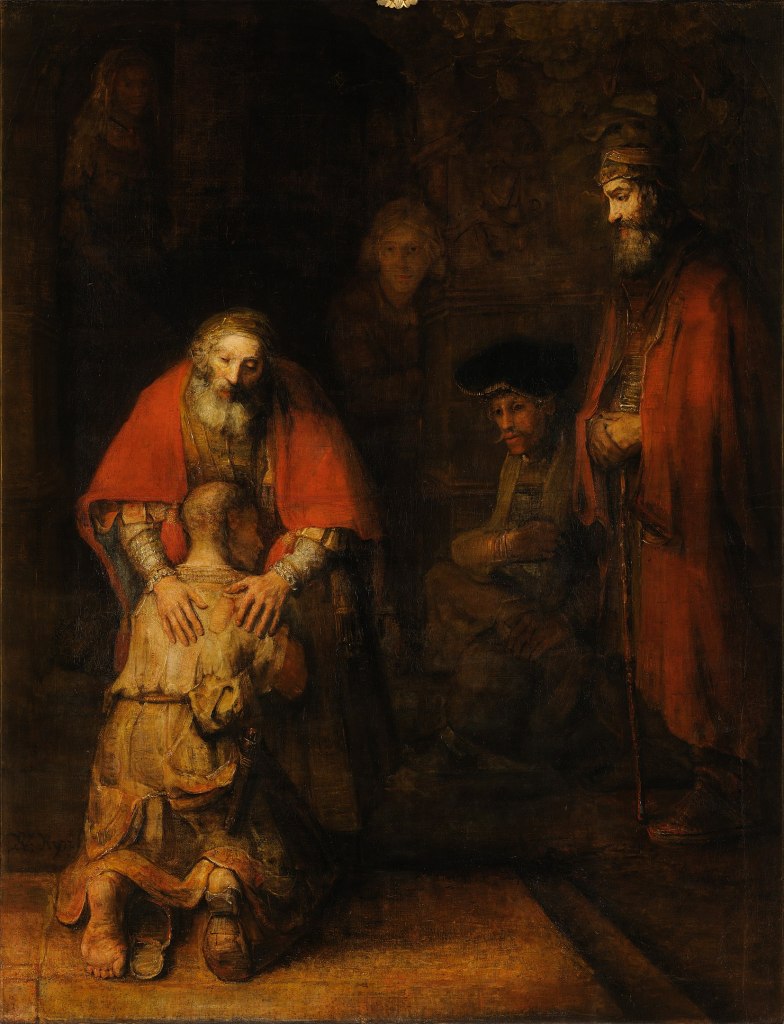
The so-called parable of the prodigal son, masterfully brought to life in this painting by Rembrandt, is justifiably famous. For most Christians, it serves as the archetypal description of our coming to Christ, explaining what it means to move in repentance from the mire of sin to the gracious open arms of God our Father. There isn’t really a better picture of the horror of our own sin and the wonder of our adoption into God’s family. Those of us who know Christ see ourselves in the redemptive arc of the son, our sin and mistakes in his pig sties, our joy in his father’s embrace.
But the younger son, the profligate who finds grace, is of course only half the story. To one side of Rembrandt’s masterpiece lurks the older son, his brother’s counterpart. He has been everything his younger sibling has not: he has honoured his father, he has worked hard, he has sought to do good. But his role as a counterpoise cuts the other way, too. Where his younger brother is driven to humility, he is proud. Where the prodigal is awash with the love and grace of the father, the older son is bitter.
In his book The Prodigal God, Tim Keller remarks on the misnaming of this parable. It ought to be called ‘The Parable of the Two Sons’, he says, for the older brother stands to teach us something as much as the younger. For a religious audience, to those already familiar with Christianity or the church, the older brother may even serve as a more essential admonition. Is his not so often our own heart, if we are believers, and perhaps especially if we have been so for a long time? The legalism that infected his outlook on life, and especially his relationship with his father, is as insidious a threat to spiritual flourishing today as it has always been. It’s seen in a kind of tit-for-tat attitude, the idea that we have earnt God’s love, with the inevitable bitterness that emerges from that. When I’ve sweated away at the Christian life, when I’ve tired myself out in the pursuit of self-denial, I find myself asking: Don’t I deserve more? Why hasn’t God given to me as much as he ought to have done?
At heart this attitude is a proud refusal to believe in and trust the truth of God’s grace towards us. We want to earn salvation, to deserve God’s love, because then it is as much our doing as it is his. This is where the older brother finds himself. And it is indeed a bitter place, a place of tears. He’s out there slaving away in the fields while the party swings on without him. But even worse, he must endure the loneliness and insecurity that comes from refusing to acknowledge the wondrous love that surrounds him. Always having to earn love, and never quite doing enough of that earning, he cannot trust that his father truly loves him. At best, it is a contingent love. His pride has cut him off from the wellspring of grace.
Keller’s point is that we’re all one of these two brothers: the prodigal or the proud. Either we are in the crucible of outright rebellion against God our Father; or we dwell in the more subtle place of pridefully believing we can earn or have earnt God’s favour.
But I don’t think this parable divides humankind into two groups; I think it divides the human heart. That was Henri Nouwen’s realisation, as he meditated on this parable and its rendering by Rembrandt. His first assumption, which has been that of so many, was of the centrality of the younger son not only to the story but to its diagnosis of the human condition. But soon Nouwen, in discussing the painting with friends, came to see in himself the haughtiness of the older brother. His meditations took his self-understanding from the archetype of redemption through the pharisaical attitude of the older brother to the open, loving arms of the father himself.
The reality of my own heart is that I have played the role of both brothers. Not only in different seasons of life, as might perhaps be expected; at times I have flitted from brother to brother in a matter of days. It is as if there were a third brother, one who joined in the younger’s shocking waywardness and the older brother’s self-righteous bitterness. That is me; and, I suspect, it is many of us.
The truth is that the older brother had no excuse for proud self-righteousness; he simply couldn’t earn his father’s love, and was foolish to think as much. But those of us who have know the pain of wandering from God’s ways, the darkness and loneliness of sin, and the wonder and sheer catharsis of grace – surely we have even less of a foot to stand on? Like the younger brother we have faced our sin, acknowledged our guilt and insufficiency, and thrown ourselves on the Father’s grace. Yet how quickly the older brother’s bitterness and pride seeps in, though we have even less of a reason for it than him. We are fickle creatures, our memories short, and the wonder of grace is too quickly lost on us.
‘Therefore, as you received Christ Jesus the Lord, so walk in him.’ It is a cliché, but we live the Christian life just as we began it: empty-handed at the foot of the cross. We grow, to be sure, but it is a growth downwards, into smaller visions of our stature and greater estimations of God’s boundless grace, daily joining our voices with John’s humble cry: ‘Therefore he must increase, and I must decrease.’ The younger brother cannot graduate to the place of his bitter sibling. Each day must be lived in the gift of the Father’s embrace.
 The Four Discoursemen