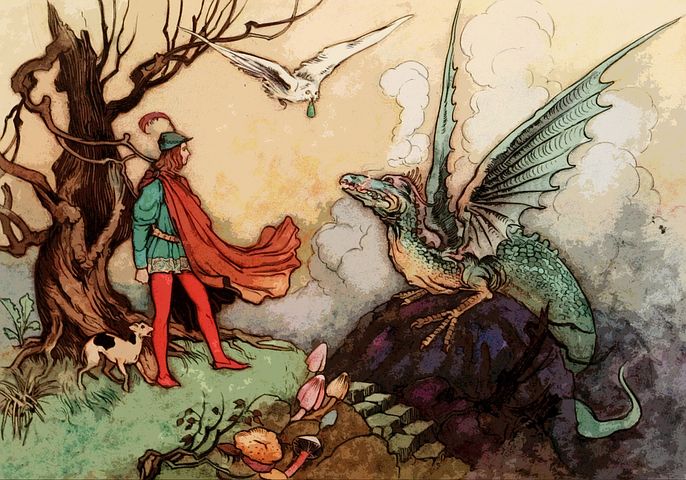
The First Discourseman
The beautiful princess leant on the balcony wall and gazed into the distance. For years she had suffered a lonely imprisonment in the castle, patiently awaiting the day when a knight in shining armour would come to slay the dragon, set her free and take her hand in marriage. She knew it was only a matter of time, for it was merely the pattern of the world.
But when help did come it was in the form of a hulking green ogre, with no time for romance or even manners. She was swept off her feet, then dragged away unceremoniously. The princess was grateful to the ogre for saving her, but couldn’t hide her disappointment that he was not the handsome prince of her dreams. The ogre had no royal title, and nor did he have any intention of marrying her. As they were escaping, she heard the roar of the dragon in the distance. “Aren’t you supposed to slay the dragon?!” The ogre sighed. “It’s on my to-do list.”
In time she grew to love him, and he her. The ogre’s heroism shone through, even as he tried to embrace his ogre identity. The princess looked beyond the green exterior and saw he had the heart of a prince, eventually forsaking her fairy-tale dreams for a muddy swamp where she finally felt at home. The ogre, with the help of a movie montage, realised he had feelings of his own for the princess.
The more perceptive reader will have realised by now this is the story of Shrek, where the cliché fairy-tale romance is memorably subverted. The handsome prince is an undignified ogre who still wins the heart of the princess, but not without bashing every fairy-tale stereotype along the way. It crossed my mind that Shrek wasn’t the only subversion of the fairy-tale that I knew; that there was a tale once told even more subversive than Shrek. It went something like this…
The ogress (?) leant on the balcony wall and gazed into the distance. Her disfigured face screwed up as she gazed into the distance. Behind her a dragon dozed in her bed. In Shrek, Donkey has the unexpected relationship with a dragon, but in this story there was a case of Stockholm Syndrome; her captor had become her lover.
Each day the dragon whispered poisoned pillow-talk into her ear, convincing her she was happier in the castle than out in the world, and that no one would ever love her like he did. She had some awareness that her life hadn’t always been like this, but nowadays she existed in a mild, passive torpor, unable to think properly. Once upon a time she had dreamed of a saviour, whereas now she got angry at the thought of one.
One day help did come, but it was not in the form of Prince Charming or an ogre. His arrival took her by surprise. A prince she had never met before, yet who felt strangely familiar, approached with his hand held out. He spoke gently but firmly, signalling some quiet, awesome strength. A bloodied sword hung in his hand and his chest heaved from the exhaustion of recent battle.
She peered down into the courtyard below to see her dragon thrashing about on the floor, in its last throes of life from the prince’s fatal blow. Still, her heart hardened and she resisted his hand, determined to live out the rest of her days in the bleak castle with only a dying dragon for company. The man patiently listened to the protests, then hoisted her up anyway to take her home.
Once at the prince’s palace she was inundated- new clothes, gifts of every kind, and a great banquet to celebrate her arrival. The ogress, to her bewilderment, was soon to be married to the prince, making her a co-ruler of his glorious kingdom.
And so she lived out the rest of her days in untrammelled joy, doted upon by the kindest of husbands. The ogress’s heart mellowed in her new life and every day her thankfulness to the prince grew, but so did her confusion.
For what kind of fairy-tale began with a disfigured ogress in bed with the dragon? A damsel who refused to leave her captivity? Certainly nothing Hans Christian Andersen, or Disney, or even DreamWorks could write. Shrek is subverted in turn by a more bizarre tale, where the one rescued is neither fair nor maidenly and the liberator is greater than either Shrek or a handsome prince.
More than just unexpected, the story makes no sense. The genre is familiar, but the story itself is too fantastic to make up. Surely there must be something lovable in the ogress for her to be worth rescuing, or something wrong with a prince whose heart is set on someone so perverse?
The prophet Zephaniah tells a tale of two cities, Old and New Jerusalem. Upon the Old Jerusalem there is a curse:
“Woe to her who is rebellious and defiled, the oppressing city!
She listens to no voice; she accepts no correction.”
The defiled city deserves nothing but shame, ruin and judgement.
Instead, she becomes God’s bride in a classic fairy-tale ending. The prophecy ends with a party:
“Sing aloud, O daughter of Zion;
Shout, O Israel!
Rejoice and exult with all your heart.
The LORD your God is in your midst, a mighty one who will save;
He will rejoice over you with gladness”.
Zephaniah, like Shrek, puts a twist in the familiar narrative to tell a new story: of the unlikeliest of romances with the most perfect of fairy-tale endings.
 The Four Discoursemen