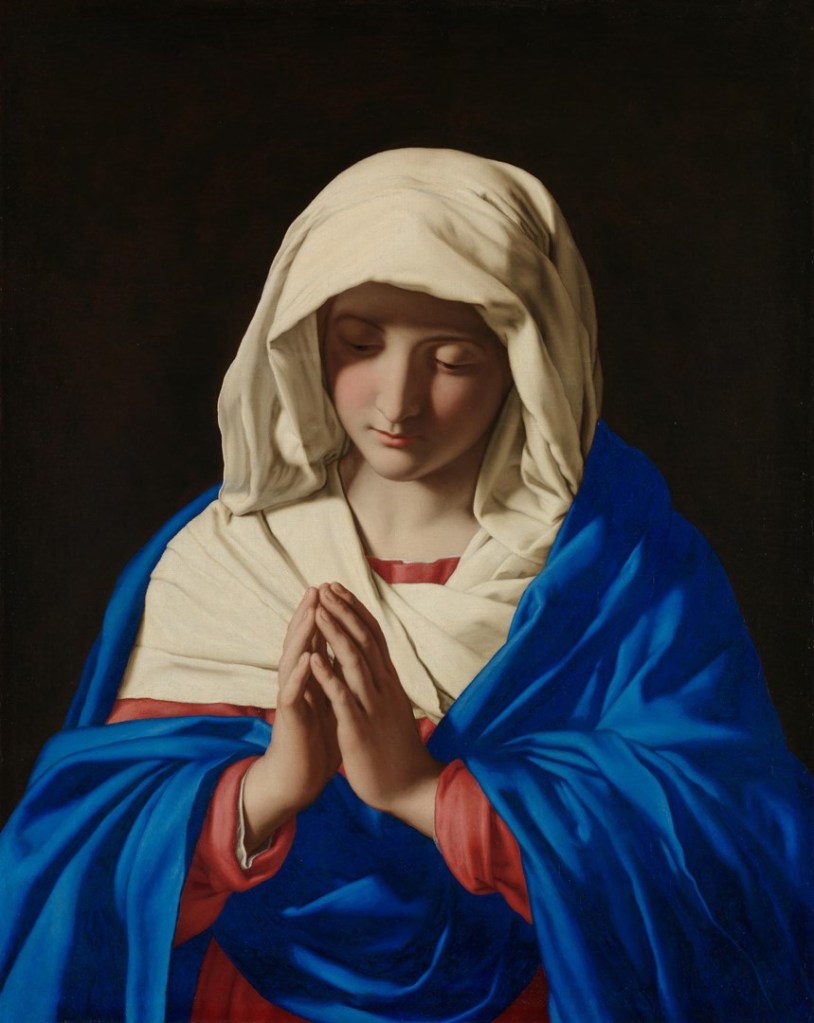
I’m getting a little tired of attempting to find new ways to express the babies and bath water trope. But it does touch upon, rather aptly, that most human proclivity to flit between extremes. To those reasonably familiar with church history, the Protestant Reformation provides examples in abundance: a time when, so we Protestants claim, the biblical gospel was reclaimed from the ashes of a corrupt church; and yet one also of doctrinal chaos, disunity, destruction, social upheaval, and conflict on a scale that has left a permanent stain on Christian religion, at least in the west.
I want to add to that rather unfortunate litany, with the suggestion that Protestants of today are rather the worse off for having failed to develop a Reformed mariology in any serious sense of the term.
Mary, the mother of Christ, has of course become a clearing house for various popish idolatries. I am always amused by the Roman appellation ‘the queen of heaven’, since the same name (Malkath haShamayim in the Hebrew) was used in the idol-worship excoriated by the prophet (Jer. 44). And to those of more Protestant sensibilities – and by extension, to most people in the anglophone world – it’s difficult not to find the seemingly endless depictions of the Virgin less than aesthetically appealing; even, to those who believe in the reformation of worship which gave us such Protestant aesthetics, downright wrong. At its worst, the adoration of Mary is a thinly-veiled papering over the cracks of cult religiosity and ritualism.
But we are running contrary to the plain testimony of scripture if we fail to honour the memory of the virgin. As Mary herself puts it:
For behold, from now on all generations will call me blessed;
for he who is mighty has done great things for me,
and holy is his name. (Luke 1:48f)
It only takes a little pondering to see how it is that Mary has come into the promise of a perpetual memory. In her womb she bears the Christ-child: she has become bound up with the incarnation of the second person of the holy trinity, the divine logos. In a sense, her body has become his temple, the dwelling-place of God with man, at least while she provides him with the first flows of life. For she gives of herself to see the Christ-child grow: her energy, her blood, her sleepless nights, and ultimately the pain of child birth itself.
Those nine months of Mary’s pregnancy were not simply a production line for a body to clothe the divine logos. That is a shallow and, if we take the councils seriously, heretical view of the incarnation. In each of Christ’s two natures, he is as much himself. Within her womb Mary nurtured, in as real a sense as my own mother to me, Christ himself.
What is the significance of this? In the west we find ourselves in a rather confused place when it comes to gender. We have created a man’s world, one in which many of the goods that are, in God’s plan, uniquely female, have been systematically disparaged and downplayed, while female flourishing has been conceived of as the capacity of women to possess those goods which have typically been ascribed to men. There are obviously a multitude of factors at play in this, and much of what has happened is undoubtedly good. But the biblical picture of the Virgin has something important to speak into this climate. Mary stands out as an affirmation of femininity, and as an affirmation of motherhood.
Before exploring these in a little more detail, we need to keep in hand an important caveat: namely, that this affirmation was not needed. Womanhood had already, in the unfolding of God’s revelation, found its fullest approbation. In the earliest chapters of Scripture we are told that ‘God created man in his own image, in the image of God he created him; male and female he created them.’ And this has continued in the natural order ever since, something Christians should not shy away from expressing. Saint Thomas famously laid down that ‘grace does not destroy nature, but perfects it’, a maxim that would be well remembered in the contemporary Protestant church. For special revelation of God’s moral order does not sit askance of that divine law which inheres in creation itself; rather, it deepens our understanding of it. Just so, when Christ shows us the beauty of covenant love in the love he has for his bride the church, or when his incarnation in the virgin womb reveals the beauty of motherhood, we are not to take it that marriage or motherhood receive something new therein, nor that somehow the God-given natural logic of these goods need not be relied upon. Special and natural revelation go hand-in-hand in the shaping of a Christian worldview, as indeed they do in Scripture itself.
(1) First, then, the Virgin affirms the sheer goodness of femininity and womanhood. There is something unique about the relationship between a mother and her child, a relationship that goes deeper than any other. To those who believe in a natural moral order, this makes sense, for a mother has with her very body brought the child into the world, a process whose moral significance is impossible to overlook. Fatherhood is, of course, profoundly important; but I do not believe the bond goes as deep. So it is all the more striking that Christ had no biological, earthly father: Joseph was, in reality, his adoptive father. It was Mary who alone was related to him in flesh and blood. And this was borne out in a closeness of relationship throughout the life of our Lord. Mary seemed to see her son in a way few else did, the result of long years pondering in her heart the mysteries of his birth and childhood. In turn, Christ’s love for his mother saw him secure for her the filial love of his own beloved disciple, for the days after his parting – even as he hung upon the cross in the agony of his suffering (John 19:26-27). It was, then, via a woman that God himself became incarnate in this world; it was a woman who was closest to him as he grew; and it was to a woman that he turned in love and provision even as he himself neared death.
(2) It is impossible to separate from this, in the second instance, God’s affirmation of motherhood. We are perhaps so familiar with the narrative of Christ’s incarnation and birth that this point is lost on us. But there was nothing inevitable, at least in theory, in Christ’s being born of a woman. The Father could have simply created a body for the Son, one in which he could descend to the earth just as he would later ascend from it. But, as the writer to the Hebrews puts it, ‘he had to be made like his brothers in every respect’, and this sharing of our flesh and blood could not but involve sharing in the experience of birth. God chose, in his infinite wisdom, that Christ be born, and born of a woman. Motherhood is so essential to human nature that his partaking of our flesh and blood would have been incomplete without it.
This latter point is perhaps particularly seasonable. In 2020, the total fertility rate reached a record low in the UK, hitting just 1.58 children per woman. Last month, the Office for National Statistics reported that, for the first time, more than half (50.1%) of women aged 30 in England and Wales have never given birth. There are of course complex and varied factors behind these trends, and I do not wish to point fingers here. But they do reflect a general move away from prizing the creation of human life, and, I would argue, the good that is motherhood. In other words, one of the most fundamental, and beautiful, elements of God’s good plan for mankind is being neglected.
In the face of this, Christians need to be what has been called ‘heroically pro-life’. This stance goes further than just condemning and seeking to end abortion, though that is of course a central part of it. But that would be to state the case merely in the negative: instead, Christians need to be active in promoting fertility, as a fulfilment of God’s creation mandate, as a means to build his covenant people, and as a celebration of one of the very fundamental goods of the natural order, and God’s common grace to all humanity.
Of course, tied to this are a variety of social goods we need to seek: goods of community, financial security, and neighbourliness, that make such a pro-life stance more of a possibility. At the same time, I am not convinced that low fertility rates come from a lack of such provision. In the west at least, we live in an age of unparalleled prosperity. And yet, as prosperity has grown, fertility has declined: far from being symptomatic of growing impoverishment, declining rates of childbirth seem to come with increased security and comfort. In such a climate, Christians need to have the courage to call our world – and first, of course, to call ourselves – not to turn from that natural good which is, for most of us, our God-given duty, and instead to gratefully embrace the sacrificial task of bringing the next generation into our world.
Against a world that would denigrate womanhood in general, and motherhood more particularly, the incarnate Christ in the womb of his virgin mother offers a striking rebuttal. Christians of all stripes, rather than conforming to the patterns of the world, should accept with gratitude the affirmation of femininity, motherhood, and childbearing that Mary provides. In so doing, we honour our God, inhabiting some of the richest blessings his hand provides.
The Fourth Discourseman
 The Four Discoursemen