Meditations upon Christmas and community
Life, I have increasingly come to believe, is all about people; and that is because it is all about love. We were made to love, to give ourselves to others without undue attention to our own concerns. And in this sense the way of the cross, the cruciform life by which Christ has loved us with the deepest love, is not contrary or even additional to our natures, but proper to us in our truest being. The life of self-denial is the good life, after which the philosophers of old so longed and whittled away long hours contemplating, often to little avail. And, since we are such social creatures, that means that the way of Christ, for all its apparent disruptiveness to the fabric of an initially pagan society, creates community in the truest sense.
We often talk about community with respect to the church, perhaps picturing bring-and-share lunches or ‘international welcome dinners’ as we do so. But the bedrock of this new covenant ‘commonwealth of Israel’ is, as with any commonwealth, the household. The redeemed household is a community of love, the place where the life-giving promises of the new covenant are most consistently present. In this sense it is perhaps the most clear exemplar of new covenant life to a world that has so abandoned any hint of covenantal commitment. For while the life of the church is at the best of times intermittent, family life is a constant, the background music to life’s more glamorous activities, a place of mutual love grounded upon a covenant that lives out in a marvellously visible fashion the constancy of God’s own steadfast love to his people.
That is why the household features so prominently in the various epistles of the New Testament. The apostle Paul, for instance, entreats each one of us, in our various roles and stations in household and in church, not with respect to our status as individuals per se, but with attention to how we relate to and compose the larger unit of which we are a part. Just as in old covenant Israel the obedience of children to their parents carried with it the blessing of peace and prosperity in the land, so that same promise holds true for the church under the new covenant, the most fully human political community. In other words, household dynamics form the bedrock of the church’s life, be it for flourishing or decay. And indeed, the church is a household, ‘the household of God’, the fulfilment of Christ’s promise that those who have forsaken their natural families will find a more steadfast family within its welcoming walls. The church is a big, bustling, multigenerational and multi-ethnic community, united by the kinship ties of grace, the natural consequence of a promised steadfast love that spans a myriad generations.
Many Christians, though still not enough, know that we can build the church and Christ’s kingdom by having families. But we also build the kingdom of God by creating households: homes united around gospel truth, filled with the peace of new covenant grace, and made beautiful to welcome the weary and lonely, and as an expression of thankfulness for the Lord’s many blessings to us.
When Ptolemy Proudfoot, a character in one of Wendell Berry’s short stories, marries the diminutive Miss Minnie, his home is transformed. Not because he is necessarily inept at matters of the household, though long days spent out in the fields can hardly have left much time to make his home more than merely functional. More because a house that is the dwelling place of one cannot be a work of love, since love by nature must find its object beyond the self. And so, although ‘the house was clean and orderly,’ Berry relates that ‘when he came home it did not seem to be expecting him, as it did after Miss Minnie came there to live.’ For that kind of expectation is the fruit of love, and we do not hope for mere subsistence only.
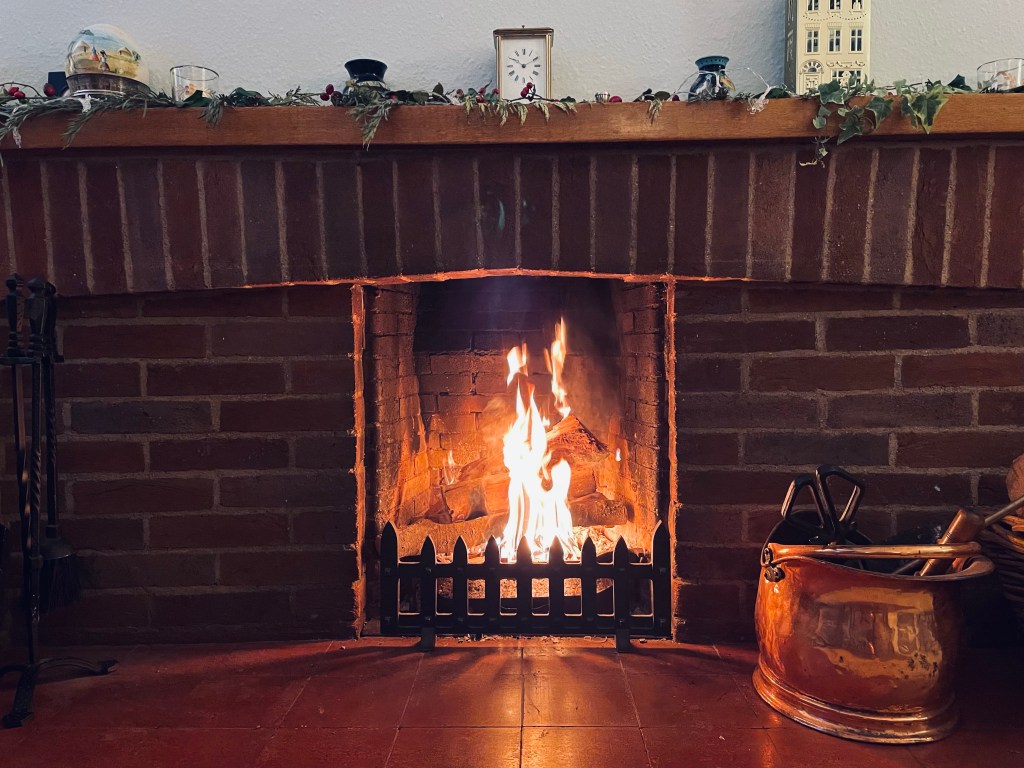
Perhaps this is never so clearly seen as at Christmas, when much palaver is had preparing decorations, balancing Christmas trees, and finding the right branches for tinsel to rest upon. Against the inhospitable darkness and rasping chill of the air – the outside world that asks of us the cold necessities of subsistence – the warmth of our homes bespeaks the tenderness of our mutual love. In a world that has become rootless, and has dismantled the home, and the communities that give to us our lifeblood, the home adorned to celebrate our Lord’s coming speaks of the quiet solidity of a love that is covenantal, and thus communal. Our Christmas traditions transport us to another age, in which family, place, and the long, slow work of local culture formed a foundation, long-laid in countless acts of love, from which we could face the many challenges and complexities of life upon a sure footing. The light shone in the darkness, that first Christmas morn; and the glowing amber lights leaking from our Christmas trees through ground-floor windows thus take on an almost sacramental quality. And yet come January, many of us blow out our scented candles and take down the nativity cards from barely-remembered friends, and we face the darkness of this world without the guiding lights of steadfast love made tangible and visible in the covenantal home.
So this is a call. If we are to build the kingdom, we must build homes: households united around gospel truth and the godliness that only true grace can bring; and households that are beautiful, welcoming, their warm hearths entreating the lonely and the lost to leave behind the cold concrete of the street and find within them a deeper, richer love than anything else this world affords – a love that makes manifest the love of God. If we build homes like these, we build up the church, and we show to a hurting world that the gods after which it yearns, and all the lonely fruits those strivings have borne it, are but a vapour before the quiet solidities and gentle peace that is ours when we make our home in the love of the living God.
The Fourth Discourseman
 The Four Discoursemen