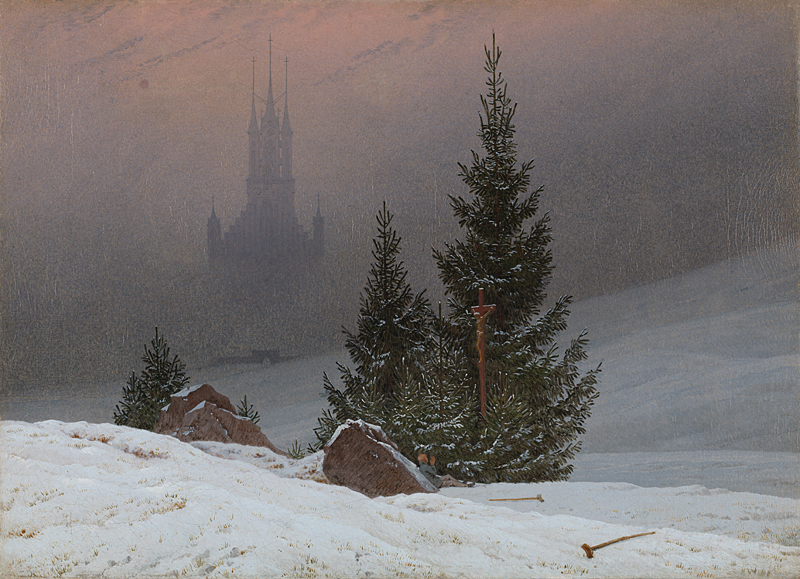
Again, the traveller’s foot plunged into the snow, and he lurched forwards, his weight swinging his other foot out of the snow. Before, his crutches had taken weight off his twisted feet, but now they anchored him more firmly into the thick, thick snow.
One crutch fell to the side, and now, lurching forward again, he let go the other. His whole body swung out of the snow this time – weightless – and he rolled down the slope, limbs no longer plunging but twisting together into a bundle, broken.
For a moment before he fell he had seen the church tower that he was aiming for. A flurry of snow had blown into his eyes, and then it was no more. He would not reach it. He lay still, his body suffused with pain rather than cold, then the pain reached his throat and he gasped into the filling chasm above. Branches crossed and fought over him. He fixed his eyes on two which stood more solidly, their angle steady. He tilted his head. They formed a right angle, and – his eyes watered and he blinked – they were not branches, but planks of wood. Among the fir trees, there was a cross.
He could not look at it for any length of time, but neither could he keep himself from stealing glances at that fixed point, though every turn of his head hurt. He did not know why the cross drew his eyes. While not a hard-hearted man, he was used to keeping his mind on immediate matters. Not like those shepherds in the Nativity scene he had passed, days ago, in the city. They were hard men, wearing down the hours of the night with their vigilance; but that same night they were changed to broken men kneeling in worship. He saw how abjectly they bowed their heads, and how pitiably they raised them to steal looks at the baby which had interrupted their steady watch.
The traveller’s eyes dropped, and at the foot of the cross he saw where his sack had rolled and spilled out into the snow. In his half-consciousness, he found himself lying at the bottom of that Nativity scene. An inch from his eyes, a fine felt hat had fallen, jewels scratching against the hard floor. There were two more hats further away, fallen from the heads of tall men who were kneeling with the shepherds. He remembered that they too had been toiling, searching for glory in the skies. Then the glory had come to them, in the form of a star. So they had begun their journey, now searching for glory among the nations. They looked far and high for palaces, and it had come to them in an open stable door.
Here they had fallen, and their crowns tumbled down with them, and their gifts rolled away to the one in the manger. The traveller remembered how they kept on rolling, in the dirt and humility of the stable floor, away from the faltering hands of their givers, all the way to a tomb. He saw his sack of earthly belongings receding from him, on the spot where his own journey had ended, and he was receding from them, and from all that the world held.
In the blackness, a woman’s face appeared, muffled in furs and cloths and snow. Then rough voices, and strong arms below him.
He remembered, many centuries ago, the face of a young woman in prayer. She prayed with a stern look for salvation for her people, then her face crinkled into a smile as she prayed for her nearing wedding. He remembered how her prayers had been answered the wrong way round, salvation announced before her life had really begun. When the baby was born, and the shepherds wept, and the wise men clasped their empty hands, she realised that she would lose more than they had ever owned.
She raised the boy all the same, as only she could. One day, the traveller saw her standing below a cross where soldiers had raised her child. At last, she heard her son speaking to her: ‘Woman, behold, your son!’ And to the man standing beside her, ‘Behold, your mother!’ Then strong arms came beneath her, as she fell into the darkness.
The traveller awoke in a bed, with a man sitting on a stool beside him. Outside the window, coloured light burned through the church’s stained glass. At first, he thought he could also hear the evening prayers filtering through.
‘O Lord, raise up thy power…’
Looking around the room, he saw an old woman rocking in a chair, with a rhythm which told that she had not left it in a long time.
‘… and come among us…’
It was her prayer he had heard, keeping as good a rhythm with the service across the street as with her chair.
‘… and with great might succour us…’
The man on the stool saw that he had woken. “Count yersel’ blessed yer ’ere. An’ not there,” he added, nodding to the blackness beyond the church.
‘… that whereas, through our sins and wickedness, we are sore let and hindered in running the race that is set before us…’
By the position of the moon, the traveller could see that he had come from somewhere in that blackness. On its edge, just across from the church, he noticed a house facing out onto the mountains, a candle burning inside.
‘… thy bountiful grace and mercy may speedily help and deliver us…’
“She were the one tha’ saw yer,” said the man on the stool. “’Er, not ’er,” he chuckled, nodding now at the house on the edge of the darkness. For a moment the traveller saw a woman in every house of that town, keeping rhythm with their rocking and with their prayers.
‘… through the satisfaction of thy Son our Lord…’
“Lost ’er son out there, she did. Cold night, that ’un too. Put up that ol’ cross, she did. Says it were for a man tha’ met them both tha’ night. Can’t say who it were, ’er bein’ ’ere and ’er son out there. Says they were both short o’ where they were ’eading. He came and met ’em there all the same, she says.”
‘… to whom with thee and the Holy Ghost be honour and glory, world without end. Amen.’
The Second Discourseman
 The Four Discoursemen