I
We have a sense, I think, that religion ought to make sense of the world. That, as we normally would have it, religion provides a ‘worldview’. Whether this is a sort of interpretative key that unlocks otherwise obscure meaning, or a grand theory of everything that claims to account for all particulars, or the source of light that opens up to us what was once expansive darkness—in all these it is meant to act as a lock-and-key solution to once intractable problems. And yet I have a suspicion that Christian religion doesn’t quite know what to do with the world.
I recently attended a performance of Handel’s Messiah—the first where I hadn’t been at the back of the action, as a result of which the acoustics were brilliant. I wasn’t expecting to be so moved by it, and yet I was; and as I listened to the magnificent trumpet solo (probably the closest anticipation of the final trumpet this side of glory), I found myself wondering quite what to do with it. Most Protestant Christians, I think, put something like this in a box, which should it be labelled would probably be called something along the lines of ‘possibly holy, but not biblical’. No one wants to deny its beauty, nor with it the beauty of man’s artistic endeavours in a more general sense: and yet, if it were sacred, who is to be the arbiter of that? In the case of the Messiah, we could attempt to circumvent this problem by putting its apparent sacral qualities down to its biblical subject matter. All of it is, after all, the word of God. But for all the undeniable and holy power of the Bible, and even for the archaic majesty of the Authorized Version, it seems unlikely that St Alban’s Abbey would have been so bursting at its seams for a weekend evening of scripture recitation. The problem we are coming up against is that in such a work of art we are dealing with inherent beauty, the sublime inhering in something that man has created, performed before our very eyes; something that is sacred not merely because it tells us about the sacred but because of something so peculiar to itself. And yet, in a world in which God has spoken, in which (we believe) the contours of his once-for-all revelation were laid down long ago, how do we account for something that is undeniably new, and yet, to us, contains not a little of the eternal?
Two ways of answering this are easy, with too much of the deus ex machina about them. One is simply that the church decides what is scared. This is what Rome does. Allegri’s Misere, a haunting setting of the 51st Psalm, received her imprimatur, with the score of that mournful piece locked away until (as legend has it) a young Mozart copied it out from memory. But, as with many of Rome’s supposed solutions to variants on this problem, this is just to kick the can down the road. Rome takes upon itself the mantle of God’s word, but in doing so it adopts the same epistemological problems that plague the simple hermeneutics of the Protestant. It is not clear how my lived experience of beauty and the divine fits with the churchly approbation or disavowal of various works or movements of art. Is Michelangelo’s La Pietà sacred because Rome says so, or does Rome says so because it is sacred? If Rome has nothing to say about Manet, must we really view his works as adiaphora?
The second approach doesn’t solve the epistemological quandary, but it does get at the chronological one. Even the Roman church, which perhaps has the most developed theology of doctrinal development, holds to the belief in once-for-all revelation. But if the revelatory activities of God reached a climax in the first century, what are we to make of subsequent cultural developments—the many beautiful works of art that mankind has produced in the long centuries since those momentous events in the ancient Levant? The simple answer is to adopt an eschatological stance—some variant of postmillennialism—that purports to account for the cultural (and other) progressions of our societies since the early Christian era. This has become a popular view in some Reformed circles: but Protestants are singularly ill-equipped to provide a robust account of cultural, intellectual, and doctrinal development. It’s not clear who decides what is in, and what is out.
II
The question of chronological developments is perhaps one for another day, and it has only ancillary relevance here. More pressing is the issue of how our experiences of the sacred, the beautiful, and the blessed, stack up against God’s revelation of himself. As the above discussion implies, this touches upon a number of interwoven questions: the authority of personal experience in the interpretation of scripture; the positivity (or otherwise) of God’s revelation; the nature of moral law. But at their heart all these questions concern a bigger mystery: the goodness of the world order, and God’s plans for it.
There is a kind of Christianity which views the world as bad. By ‘the world’ I do not mean, in the Johannine sense, the sinfulness of the present age, the powers that range against God and his people. I mean the created order—the cosmos that God long ago called forth from nothing and which was, on his first estimation, ‘very good’. The problem is that these ancient words describe the status quo before sin entered into the world. Since then, the curse of divine wrath has spread over what was once the object of his delight. And this is where this pessimistic Christian mood originated. All that we see is cursed: but it will be done away with, and all will be made new again. The point is not to delight in the slow-sinking ship of this age, but to clamber aboard the only lifeboat we have, looking ahead to the newly-refashioned ship that awaits us.
This kind of view has troubled even those writers, thinkers, and artists who are most sympathetic to Christianity. Almost all art starts with some kind of delight in the created order, even if it is a perverse delight. We see something beautiful in the world and we want to capture it, to exposit it, and in doing so perhaps to sanctify it. The Christian God, the benevolent creator who stands behind and is the source of this beautiful world, provides both an explanation for the source and font of natural wonder, and a direction for the praise that so readily fills our hearts when we meet it. But so often those drawn as such to the God of the Bible are put off when they encounter the otherworldly preoccupations of the Christian creed. It seems a cruel about-turn in spiritual development: the cold, nameless earth of a godless world gives way to the homely blessings of a God who both creates and loves, only for that God to demand his worshippers to scorn that creation and forsake what they had thought he loved.
To someone caught in this conundrum, it isn’t clear what way to proceed. Samuel Taylor Coleridge may have overflowed with love for a world in all its aching beauty: ‘Methinks, it should have been impossible / Not to love all things in a world so fill’d’—but where else could he direct such praise but to the faceless God of the pantheist?
And what if all of animated nature
Be but organic Harps diversel fram’d,
That tremble into thought, as o’er them sweeps
Plastic and vast, one intellectual breeze,
At once the Soul of each, and God in all?
The rebuke of his wife, who ‘biddest [him] walk humbly with [his] God’, seems a little flat after such a flight of fancy, and Coleridge cannot seem to reconcile the marrow of gospel truth—‘who with his saving mercies healed me’—with his innocent natural delight. The orthodox check on his wandering imagination is a riposte that offers no resolution.
The suspicion of a figure like Coleridge is that there is an unadulterated wonder to life on earth, with all its pleasure and pain—‘the holiness of direct desire’ brought out so quaintly in E.M. Forster’s A Room with a View—that the otherworldliness of Christian religion cannot reckon with. Wendell Berry’s character Jayber Crow, a lonely figure of the Port William ‘membership’ around which all Berry’s fiction revolves, is driven by this very suspicion to walk away from his seminary education and to sit askance of the Christian life of his village. The string of young pastors who pass through Port William have a fierce otherworldliness of doctrine—‘they learned to have a very high view of God and a very low view of His works’—but neither they nor their people seem to have been convinced by it, something that Jayber marks with some amusement:
While the wickedness of the flesh was preached from the pulpit, the young husbands and wives and courting couples sat thigh to thigh, full of yearning and joy, and the old people thought of the beauty of the children. And when church was over they would go home to Heavenly dinners of fried chicken … And the preacher and his family would always be invited to eat with somebody and they would always go, and the preacher, having just forsworn on behalf of everybody the joys of the flesh, would eat with unconsecrated relish.
III
It is important that we listen to these things. They pick up on a tension, a paradox central to Christianity and yet found also in the world at large: that we live between the eternal and the quotidian, between sin and redemption, between the old creation and the new. These are the Exodus years of the earth. We have the Tabernacle, but not yet the Temple; we have received the law, but are not yet a nation. We delight in this world as much as the Israelites savoured cool water that flowed from the rock, but we acknowledge that it is impermanent, fleeting as the grass of the field—but that one day all will be made new, and all will be eternal.
But writers like Coleridge fail to see the beauty of a mind set upon things above—something that slowly dawns on Jayber Crow. This-worldliness might seem sufficient for a season, in days of peace and blessing—and more than that, I have long suspected that the purpose of most art and literature is to make it seem sufficient in fallow times as well, times of hardship, by enduing them with some sense of the eternal or of a significance beyond themselves. But if Berry believes much of Christian other-worldliness to be an abdication of the responsibility to face up to the sheer goodness and beauty of the world, this kind of art, which eulogises loneliness, loss, and even depravity, abdicates from the responsibility of facing up to the darkness, futility and decay of this world. We are like grass. And while death may teach us to enjoy life, it also makes a mockery of us doing so. And this is why, for all their celebration of our sheer humanity, Berry’s novels ache with a gentle pulse of loss and sorrow. None of it lasts.
In this sense, the other-worldliness of Christianity is brave and unabashed. It looks death straight in the face; it acknowledges our earthly end; it reasons as to eternity. And then it lives in light of eternity. In times when death and decay have loomed near over myself and my loved ones, I have been thankful for that.
But nor is Christianity exclusively focussed on the next world. It has a rich earthiness to it. This is where many go wrong. The clue, as it turns out, is in the nature of the next life, which is not abstract or ethereal. It is a new creation: the making new of all that already is. Even the great cultural achievements of millennia of human society, far from being cast off, will be present—brought into the hallowed halls of the heavenly Jerusalem. This is the whole point of redemption: not to do away with the world but to remake it, to refashion it in perfect love and formliness. Perhaps the wonder of it is lost by familiarity. But everything in the account of man’s descent into sin bespeaks only one fate for the young cosmos: destruction. How could a holy, benevolent, creating God endure the scorn of that which he, out of the mere abundance of his good pleasure, had created? And yet he more than endured it: he acted to save us from it. He became man, he suffered and died and faced all the gall of man’s evil, so that we—and all creation with us—might be redeemed. The cross and resurrection of Jesus Christ is the great and divine imprimatur on all of creation: marred though it is, God is in the process of redeeming it, and the final consummation of that redemption will be both more glorious and more real than the world we now know.
To know the Christian God is to know not only the God who is being, and who has created all things, but the God who is redeemer, saviour, and Father. Like nothing else, this enlivens, beautifies, and quickens both nature and our appreciation of nature. The old hymn knows it well: to the Christian believer,
Heaven above is softer blue,
Earth around is sweeter green,
Something lives in every hue,
Christless eyes have never seen:
Birds with gladder song o’erflow,
Flow’rs with deeper beauties shine,
Since I know as now I know,
I am his, and he is mine.
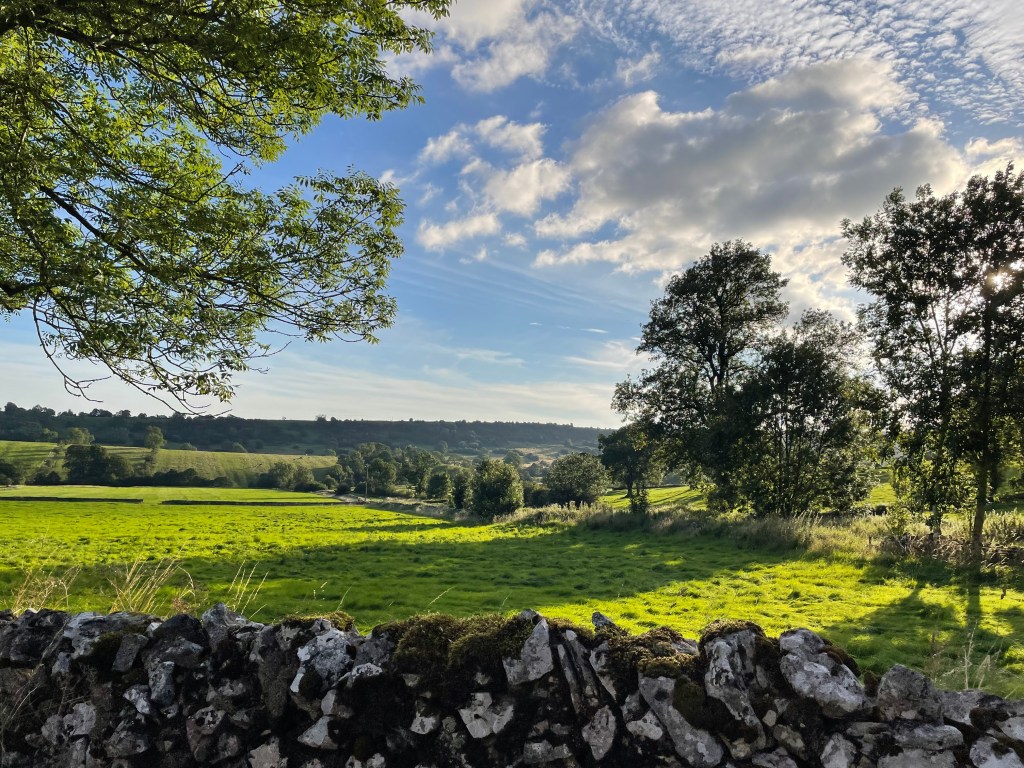
The picture is unapologetically romantic. To the lover, it is as if every hour is golden hour, and in new love the ordinary things of nature seem to sparkle with brighter lights. The same rains that appear drab and apathetic to the weary soul promise verdant pastures to the one in love. It is all riddled with the subjective. But to know nature’s God—to be in love with him—is to see with a penetrating gaze the deep secrets of nature more clearly than do the most erudite of natural scientists. When we know God as Father, and understand his redeeming purposes, we can delight in creation like no one else can. The God who knows and loves me is the one who made the flowing highland coasts and Scotland’s windswept hills; who dapples falling leaves with gentle golden light; who fashioned each of the ‘silent icicles, / Quietly shining to the quiet moon’ that bedeck our forests by winter. And he made men and women, in all their sighing beauty: and in his image we have fashioned all the treasures of the nations.
If we Christians are not always sure what to do with the world, it is because we live between two worlds, between the long longed-after comings of Christ. He has ushered in his kingdom, and he will make all things new. In the meantime, as the centuries roll by, we are not always sure what he is about in the world. But we can be sure that this is his world: that the Triune God made and fashioned it, loves it, and is redeeming it.
The Fourth Discourseman
 The Four Discoursemen