A Positive View of Sin

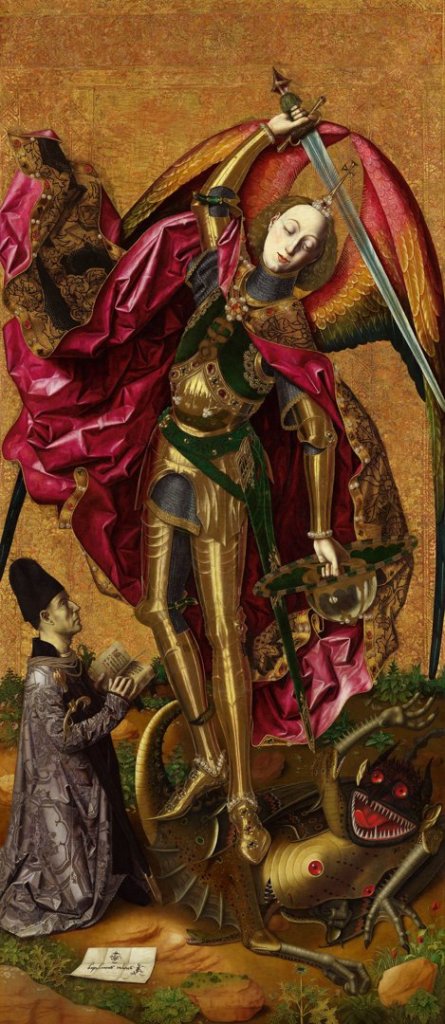
Bartolomé Bermejo, St Michael Triumphs over the Devil (1468)

It is common today to hear sin described in negative terms; that is, as a lack, or as an inferior substitution for something better. C. S. Lewis’ quote on mud-pies is often employed, and one hears it whenever a church decides to improvise its own confession; the latest I heard included an admission that we put our own ‘short-term agendas’ before God’s eternal purposes. The lanyard-esque language belies a lack of seriousness about sin. Possibly, one can paint every vice as an absence of virtue or as a rejection of grace, but this must not be the only picture we paint. We must revolt ourselves with the positive wickedness of sin.

Continue reading “A Positive View of Sin”

The hardest humility

I generally think I’m quite a humble person. You’re not meant to say that, of course—at least, not in Christian circles—and perhaps genuine humility is so accompanied by a dose of the self-effacing that to say as much is a contradiction of self-reference like the great paradox of Epimenides (Titus 1:12). But that’s by-the-by: this blog has always been a place of the utmost honesty, and I’m sure my readers don’t want that to end with a show of faux-modesty. The Christian world is rather too full of people saying what they’re meant to say—totting out the party line, so to speak—that cutting back the religious brambles to get to what we actually believe can sometimes be a rather exhausting exercise. I thought I’d spare you the trouble.

Continue reading “The hardest humility”

Jesus the Risen Lord

Sunrise Dawn” by Travel Coffee Book/ CC0 1.0

The third discourseman

The following are all the direct references to Jesus’ resurrection that I could find in Romans. I’d recommend picking just a few to meditate on and read slowly. You can then read my bullet-point thoughts below. You can either go through them quickly, and get a sense of the overwhelming strength and depth of the theme of ‘resurrection’ in Romans, or pick a few to match up to the corresponding verses, and again spend a bit more time pondering.

‘and was declared to be the Son of God in power according to the Spirit of holiness by his resurrection from the dead, Jesus Christ our Lord’

Continue reading “Jesus the Risen Lord”

Top tips for American expats

No denizen is quite so unable to recognise where their own culture ends and another begins as the American expat. Perhaps that’s because their ‘culture’ is really just capitalism, and what the big beasts of capitalism can never quite grasp – never want to grasp – is that there might be some things beyond the reach and grab of the market. But Americans betray a curious inability to observe their own cultural particularities. No matter how many passive aggressive pavements, cafetières or maths equations might issue from the mouth of a lightly kerfuffled Brit, they just don’t seem to get it. And it gets them entangled in endless social faux pas, many of which I’m sure they don’t notice. Only the other day I went a good few minutes into a conversation I had thought was about riding (though I couldn’t ascertain if we were speaking of the equestrian or mechanical kind), only to find after much confusion that it had always been about writing, with a ‘t’ – a point I shall touch upon below.

So, magnanimous character that I am, I thought I’d help out our American friends – teach them a lesson or two about how things work outside the land of the free, and more specifically in the bog-ridden ‘tiny island across the sea’ that is Great Britain.

Continue reading “Top tips for American expats”

Orthodoxy is a friend of the young

At a casual glance, it appears that today’s progressivism is largely driven by older generations. Grey-haired protestors glue themselves to motorways, and tubby vicars with hearing aids revel in all the ways a man can pretend to be a woman. This poses an immediate challenge to a young person with a conservative bent. His instinct, indeed his principle, is to listen to and respect his elders; but many of those elders despise all that he holds dear.

Continue reading “Orthodoxy is a friend of the young”

Slaves of science

The Third Discourseman

We live in a country where those who are supposed to rule us are themselves ruled. Where politicians and policy makers are simply following orders. And what is it that rules the rulers? That commands the commanders? That barks orders at those who order our society? It is neither man nor machine, neither individual nor state. It’s something bigger and more intangible than that. This master goes by many names. This master is invisible. But those that follow it will alert you to its mastery of them. They’ll tell you outright:

‘We’re just following the science.’

Continue reading “Slaves of science”

The Pursuit of Christian Internationalism, and why I’m pro-EU after seven years of wandering

Photo by NastyaSensei on Pexels.com

Some Christians are leaning hard into nationalism nowadays, which I think is risky. Last year, Stephen Wolfe published The Case for Christian Nationalism. Wolfe defends nationalism as a prelapsarian, God-given instinct, naturally flowing from the command to be fruitful and multiply in number. Regardless of the Fall, Wolfe argues, families and tribes would have spread throughout the world, inevitably forming cultural differences and developing loyalties to their individual communities. Importantly, in this framework (and I believe this point is often missed by critics jumping to conclusions) the Tower of Babel is God’s judgement upon Empire, not nations; it is the erasure of national differences, as humanity works towards a common idol, that draws God’s ire.

Continue reading “The Pursuit of Christian Internationalism, and why I’m pro-EU after seven years of wandering”

This Waiting World

I

We have a sense, I think, that religion ought to make sense of the world. That, as we normally would have it, religion provides a ‘worldview’. Whether this is a sort of interpretative key that unlocks otherwise obscure meaning, or a grand theory of everything that claims to account for all particulars, or the source of light that opens up to us what was once expansive darkness—in all these it is meant to act as a lock-and-key solution to once intractable problems. And yet I have a suspicion that Christian religion doesn’t quite know what to do with the world.

Continue reading “This Waiting World”