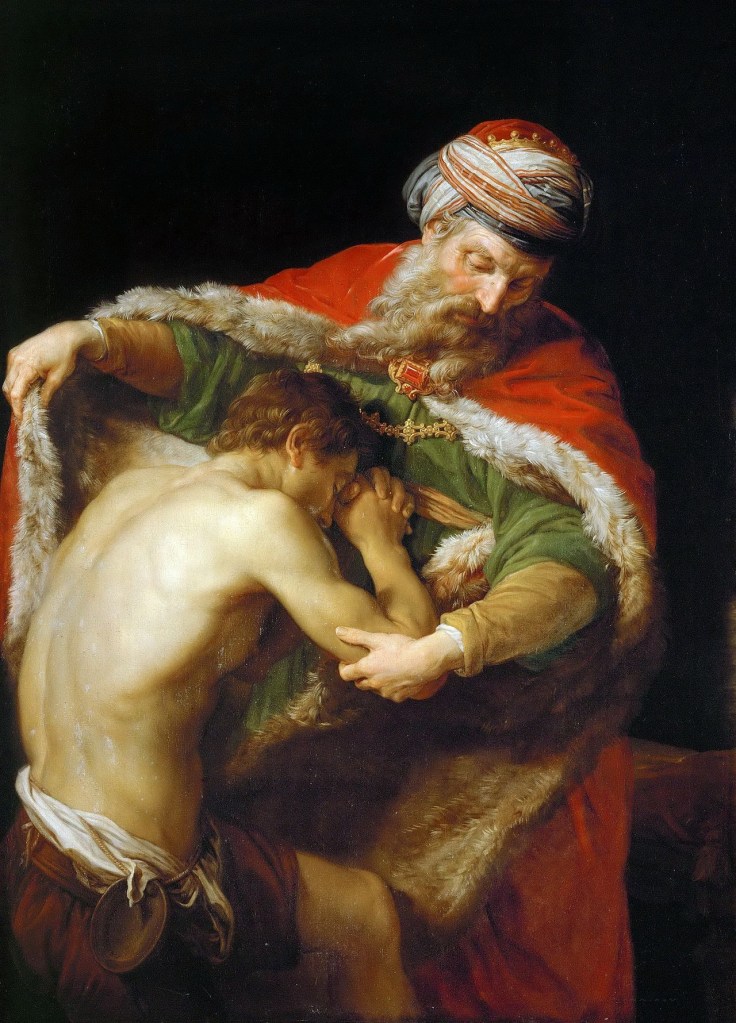
Pompeo Batoni’s The Return of the Prodigal Son (1773)
The Third Discourseman
Once again, a bold title. The father I am talking about is not God the Father (whose love is almost certainly more surprising than you think), but the love of the father in Luke 15 (which I suggest you read now, and then have open in front of you if you want to make the most of this blog) and the parable of the prodigal son.
‘But hold on’ I hear you object, ‘Isn’t the father in Luke 15 supposed to represent God the Father? Surely not even the Third Discourseman could be so bold as to suggest otherwise? Surely he hasn’t devised some new interpretation that’ll blow our thinking on one of Christendom’s most beloved parables wide open?’
In this article, I write about suicide and abortion. I have tried to write both clearly and carefully on a difficult and important topic, but it is possible that my words may still cause hurt to some readers.
Why, even the hairs of your head are all numbered. – Luke chapter 12 verse 7
With none to heed their crying For life and love and light, Unnumbered souls are dying And pass into the night.
This is a season of saying goodbye. In a few weeks a good friend moves back to Australia, where he is from. Even with modern communication possibilities, it’s a challenge keeping in touch with folk in Sydney, with the near day-long time difference. Another close friend – a Discourseman no less! – has upped sticks for Sydney already, this time with the promise of return after a year of letting off steam. But while a year may fly by, it does so only because life itself flies by; we manage to get an awful lot done in the short time God allots us. Again, modern technology promises much in keeping us connected. But my world here moves on, and it does so at its own speed, with not so much as a passing consideration of happenings half a world away, save for the odd intrusion of a catch-up over a FaceTime call.
Today I visited a new church, and decided that I would call it home. I hinted this to some of the people I spoke to, but not in such personal terms. After all, to claim a place as home is presumptuous in the extreme. It is to demand that those who dwell there love me as a member of their family; me, whom they have only just met and know nothing about.
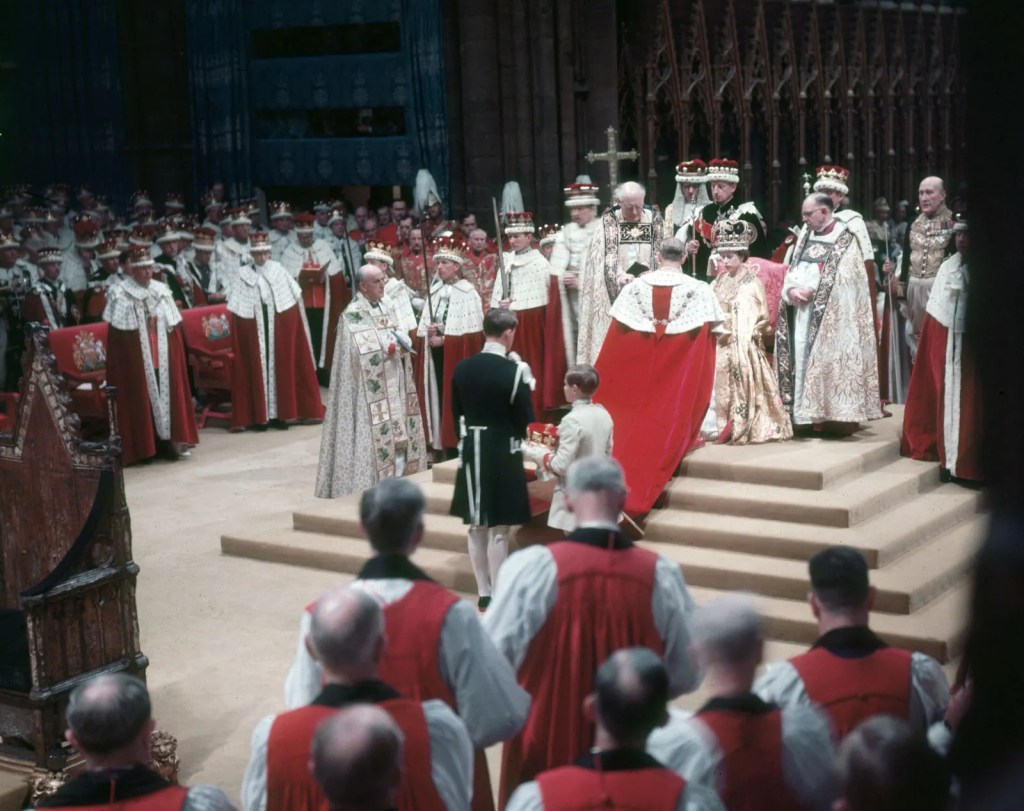
The coronation of her Majesty Queen Elizabeth II in 1953
I have waited some three days now to gather my thoughts and prepare my pen to offer a fitting tribute to her late Majesty. But I fear I have waited in vain. Grief comes to us in many guises, and we can but clutch at straws in trying to grasp at its complexities. But how much more so upon the death of a much-loved sovereign, of someone in that unique position of having been such an immutable and axiomatic feature of so many of our lives, and yet whom but a few of us knew personally. Our modern, iconoclastic age has not bequeathed to us the apparatus to understand or cope with such an occasion, and such a grief. And indeed, many will have been struck by the absurdity of a society so zealous in its progressivism, so militant in its pursuit of an all-encompassing meritocracy, now nonetheless forced to observe age-old traditions and to pause its hurried life to mark the death of a woman who occupied a position, and fulfilled the duties of a role, that few had not come to regard as at best archaic. Yet the outpouring of grief, and the genuine sense of solemnity that have followed the death of the Queen, speak of a society that has still, in spite of itself and all its propaganda, an attachment to the ideals of majesty, beauty, and order that underlie the institution of monarchy. Perhaps what Louisa May Alcott once called ‘that reverence for titles that still haunts the best of us’ survives more robustly than we might have supposed.
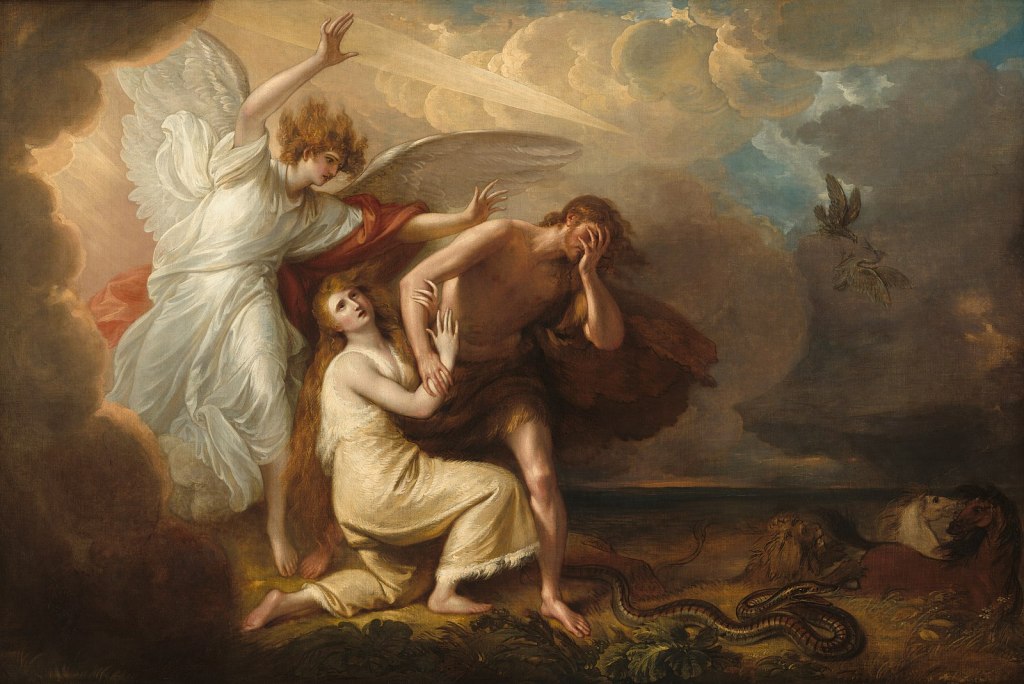
Benjamin West’s The Expulsion of Adam and Eve from Paradise (1791)
The Third Discourseman
I wonder if you’ve ever heard a Christian, even a conservative evangelical, tell you that we live in a broken world. I guess this says something helpful, namely that the world is not functioning as it originally intended. But I don’t really like the phrase. It’s like, ‘Oh no, the fridge broke, we need to get a new one.’ ‘Whoops, I just broke a plate, sorry.’ Most of the time when we say something is broken, the way it broke was either incidental, some sort of fault we were completely unaware of, or accidental, some sort of clumsy mishap.
I don’t think I had ever noticed moonlight until a couple of years ago. This is strange considering the part it played in so many stories of my childhood: poachers, smugglers, spies, all making their dubious ways under the silver gleam. But though we see the Moon, it is rare today for a city-dweller to notice its light. Tonight there was an especially magnificent Moon, white in its brightness and orange in its warmth. I caught a glance of it from my bedroom window, and went looking for it in its fullness amongst the fields.
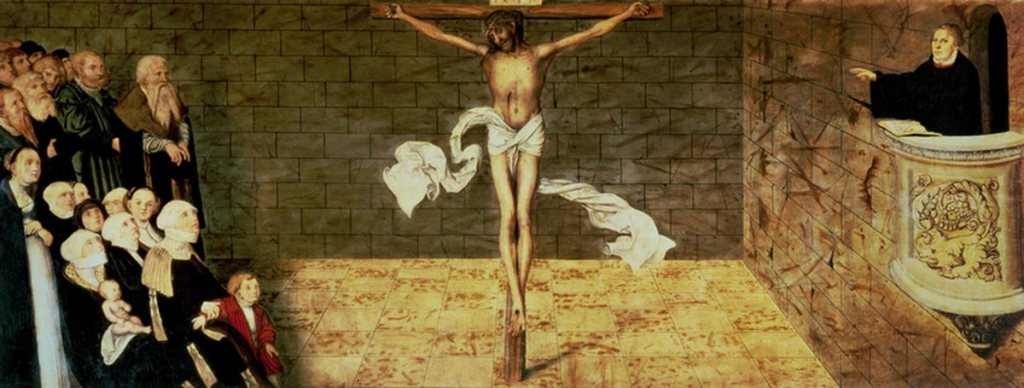
A Reformation altarpiece by Lucas Cranach the Elder, depicting Martin Luther preaching (1540s)
The Third Discourseman
A bold title, I know. So to avoid unnecessary offense to my fellow Reformed brothers and sisters reading this blog, I want to stress that I believe in both justification by faith alone and penal substitution. Both are true and wonderful and vital to our salvation. This blog is not calling either into question, nor is it questioning either’s central importance in systematic theology, orthodox Christian faith or pastoral care.
On Sunday morning, the only email in my inbox is from Microsoft’s Viva, giving me its usual daily briefing. It doesn’t mind working on Sundays. Out the window, a different robot chirpily, absent-mindedly mows the lawn, because that’s what it’s programmed to do. It doesn’t mind working on Sundays either. The family could move out the house, the house could be demolished, the grass could grow wild for miles around, and still it would continue mowing its little patch.
I hear a lot of complaints about ‘the church’ these days. I’ve been guilty of them myself. Why don’t Christians give more money to the poor? Why is British Christianity so middle class? Why aren’t we preaching the gospel properly? Why all the abuse scandals?






 The Four Discoursemen