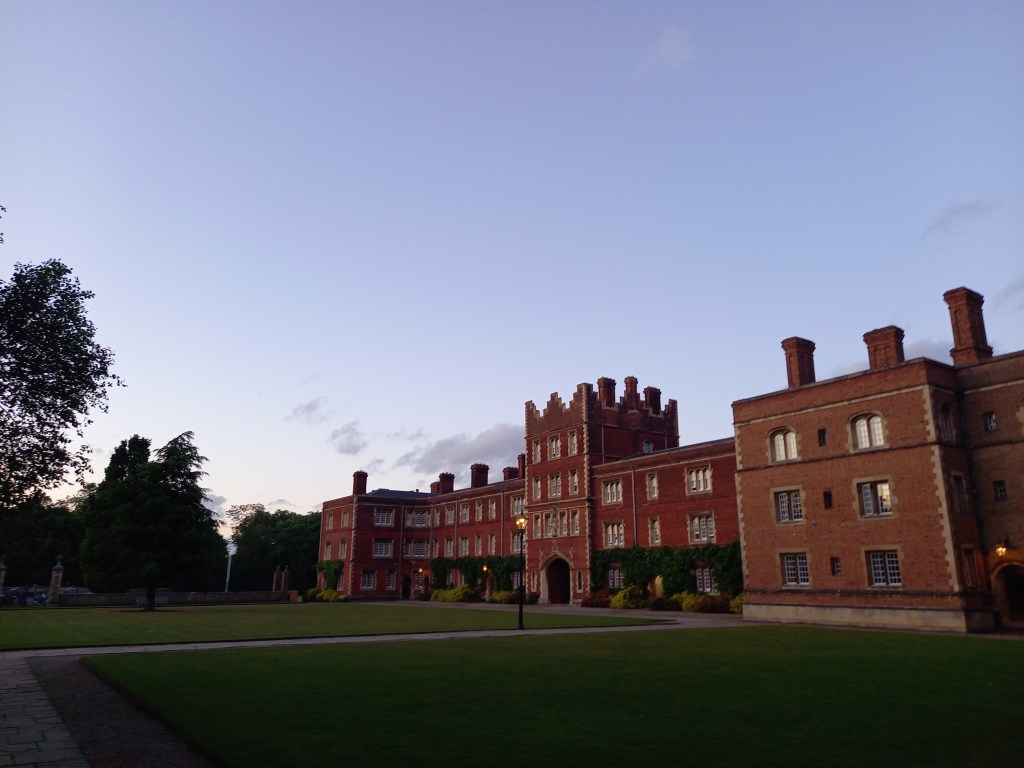
In the dusk tonight, I sat in Chapel Court of Jesus College, my alma mater as of this day. I had just graduated a year after I had left, so that it was both a return and a farewell. Life played out across that court: couples walking together, students traipsing back and forth from the library, the sounds of friendship through open windows. It was open to the heavens, so that the light of stars was in the place, but the walls were tall and quiet.
My uncle and aunt have a dog called Meg. I don’t know enough about dogs to be able to say if Meg is an odd dog, as in, odd as far as dogs go. But she seems odd to me: she gets easily hyped up and overexcited, she has an annoying (but sometimes funny) knack for getting at food that’s been put in the middle of the table, and she gets strangely timid around particular other breeds (one very hairy and quite elegant dog had her cowed the other day). But the most striking thing about Meg is how touchy-feely she is. I met a dog called Linus a few weeks back, who wailed (insofar as dogs wail) when we left him. Meg’s like that, except that even more than Linus she needs physical contact with humans: holding her paw, rubbing her belly, giving her a hug.
I don’t know whether this statement is actually true. Has there ever been any data or research (beyond anecdotal) to suggest that the British are more inclined towards the underdog than any other nationality? Is it even true that British people love an underdog more than an ‘overdog’? People love seeing big upsets like Leicester winning the Premier League, but they also love seeing mega-stars like Ronaldo and Messi breaking records and winning again and again. They love the shock of an unexpected result and the excellence of a clinical team/nation/individual operating consistently at the highest level.
I recently finished reading Patrick Deneen’s book Why Liberalism Failed. I hadn’t actually heard of it until recently, when it was pointed out to me that my claim that the big state is the close friend of individualism was already the central thesis of Deneen’s work. (Unsurprisingly, my ideas aren’t exactly original: and nor should they be.) So I popped Deneen on the mental shelf as a probably-should-read kind of a thinker. Then I happened upon a particularly insightful Paul Kingsnorth article on Unherd that sang Deneen’s praises even more profusely than had the First Discourseman to me: this book is ‘perhaps the most reliable guide to the world we live in now’. If true, that’s a good thing; we’re all in need of a few guides these days, though I’ve read enough of Kingsnorth not to expect cheery reading from contemporary commentary that receives his approbation.
I’m getting a little tired of attempting to find new ways to express the babies and bath water trope. But it does touch upon, rather aptly, that most human proclivity to flit between extremes. To those reasonably familiar with church history, the Protestant Reformation provides examples in abundance: a time when, so we Protestants claim, the biblical gospel was reclaimed from the ashes of a corrupt church; and yet one also of doctrinal chaos, disunity, destruction, social upheaval, and conflict on a scale that has left a permanent stain on Christian religion, at least in the west.
The day Thou gavest, Lord, is ended, The darkness falls at Thy behest; To Thee our morning hymns ascended, Thy praise shall sanctify our rest.
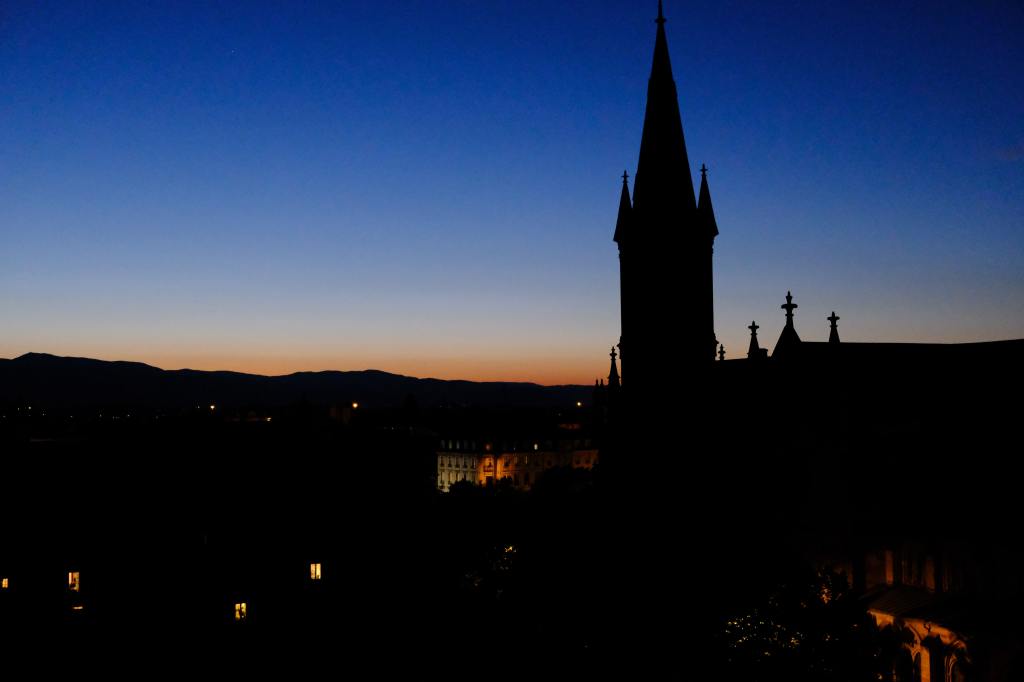
It is hard to pin down the feeling as I leave church into the Sunday evening’s darkness; a feeling which, though it presumably has its counterpart in all working folk, can only reach its full dimensions in those who have come from meeting in the presence of the Divine. It need not be so much as sadness or worry, for the week ahead may hold no particular gloom. It is not loss, since Sundays come as often as they go and their finiteness is not usually obvious. I think it can only be described as it is, which is the stepping from light into twilight, from beholding our God to facing earthly life once more. It is the fundamental human experience of night coming.
That’s right, you read the title correctly. No figure- no matter how beloved- is safe from this Discourseman’s hard-hitting journalism. And no figure has escaped deserved scrutiny more than Santa, everyone’s favourite festive fable. For those unfamiliar, Santa Clause is the fictional lead at the centre of a nexus of lies, global in scope. He’s a legendary jolly old man that hands out gifts across the known world every Christmas. His mythology typically includes features such as his residence in the North Pole or Lapland, his use of elves for manufacturing and a reindeer-driven flying sleigh for distribution, his use of chimneys to enter/exit homes and his iconic white beard and red suit. And this mythos is fed by parents everywhere to their young children, who believe this figure to be real, and the real source of some (or all) of their Christmas presents. There are many reasons to be disturbed by this set of circumstances; this article will merely present 10. Enough foreplay- let’s get on with the iconoclasm.
‘When I had done all that, I got him oats from the neighbouring bin; for the place knew me well, and I could always tend to my own beast when I came there. And as he ate his oats, I said to him: “Monster, my horse, is there any place on earth where a man, even for a little time, can be as happy as the brutes? If there is, it is here at The Sign of The Lion.” And Monster answered: “There is a tradition among us that, of all creatures that creep upon the earth, man is the fullest of sorrow.”’
A communist-era block of flats in Katowice, Poland
Here is a conundrum: if my last article was right, and westerners increasingly operate in an autonomian conception of things, then how do we explain widespread compliance with the authoritarian measures taken by governments in response to the pandemic? The rhetoric, at least in the early months of it all, was of pulling together, of coming alongside one another to defeat a common enemy. In Britain the prime minister seemed to enjoy his Churchillian moment, mustering a degree of composure in those early press conferences; this, combined with ‘clap for carers’, and strangely enthusiastic zoom quizzes (not to mention family ‘get-togethers’) seemed emblematic of a national unity that is, to say the least, rather rare. Much of that has fractured now, as the virus approaches its third year, and one is struck with a curious sense of déjà vu upon perusing the latest headlines. But still the impassioned pleas of the vaccine evangelists make recourse not so much to individual freedom as to that same old virtue of the greater good: protecting the vulnerable, looking out for the many, not the few – that sort of thing.
I’ve often found the phrase ‘Don’t judge a book by its cover’ a bit odd. After all, the cover is still part of a book, and has still had some sort of paid designer/artist behind it, who has hopefully put effort into making it grab people’s attention and compel them to read on. So when this effort has failed, why shouldn’t their work be judged? At the very least, we should be able to judge the cover, along with the rest of the book, as a piece of art.







 The Four Discoursemen