The existential community

I

I don’t think it’s a particularly original observation that western modernity’s exaltation of individual autonomy has done us much harm. Of course, modern individualism has brought us a lot of good, that I hope not to take for granted. For all that many of us, and perhaps especially the contributors to this blog, might express frustration at certain aspects of our society’s makeup, we are nonetheless children of our time. So the lens through which I am viewing the problems of secular autonomy is very much one soaked in the thought-world of secularism itself. That ought to be borne in mind in what follows: I am critiquing western individualism, but I am myself a westerner, and I can’t escape that.

Continue reading The existential community

A Coronavirus Advent

The Second Discourseman

Through the year, no season gives us such consciousness of time as Advent. We experience both the brevity of daily light and the sluggishness of winter, as we wait for the eternal Light to come once more into our world. This year it is even more stark. Our liberties seem likely to be quickly curtailed, and we wonder whether Christmas in its festive fullness will have to wait another twelve months. It has been suggested that these pandemic winters are the first in a long time which cause anxiety by the simple virtue of being winters. As our ancestors did year in, year out, we too brace ourselves.

Continue reading “A Coronavirus Advent”

The Long Work of Conservatism

The Second Discourseman

I am inspired by The Fourth Discourseman’s article, Christianity, Conservatism, and the Tyranny of the Present.

Amid the unhappy conflict between conservatism and progressivism, it is easy to forget that at heart these are just two different views of time. They are no more than expressions of frustration at our pace through this fallen world. Some see the second hand spinning away from all that we hold true and dear, while others yearn for the sun to rise faster, and bring us into the light of dawn.

Continue reading “The Long Work of Conservatism”

Is nominalism that bad?

The First Discourseman

Is there a greater evil than religious nominalism? A carapace of piety masking the unrepentant heart; salvation received through communion and confession; or a culture where the Church has been irredeemably conflated with the state. Nominal Christianity is where the right things are done for the wrong reasons, or when people pay lip service to the God they may not worship in their hearts.

Continue reading “Is nominalism that bad?”

A mind renewed

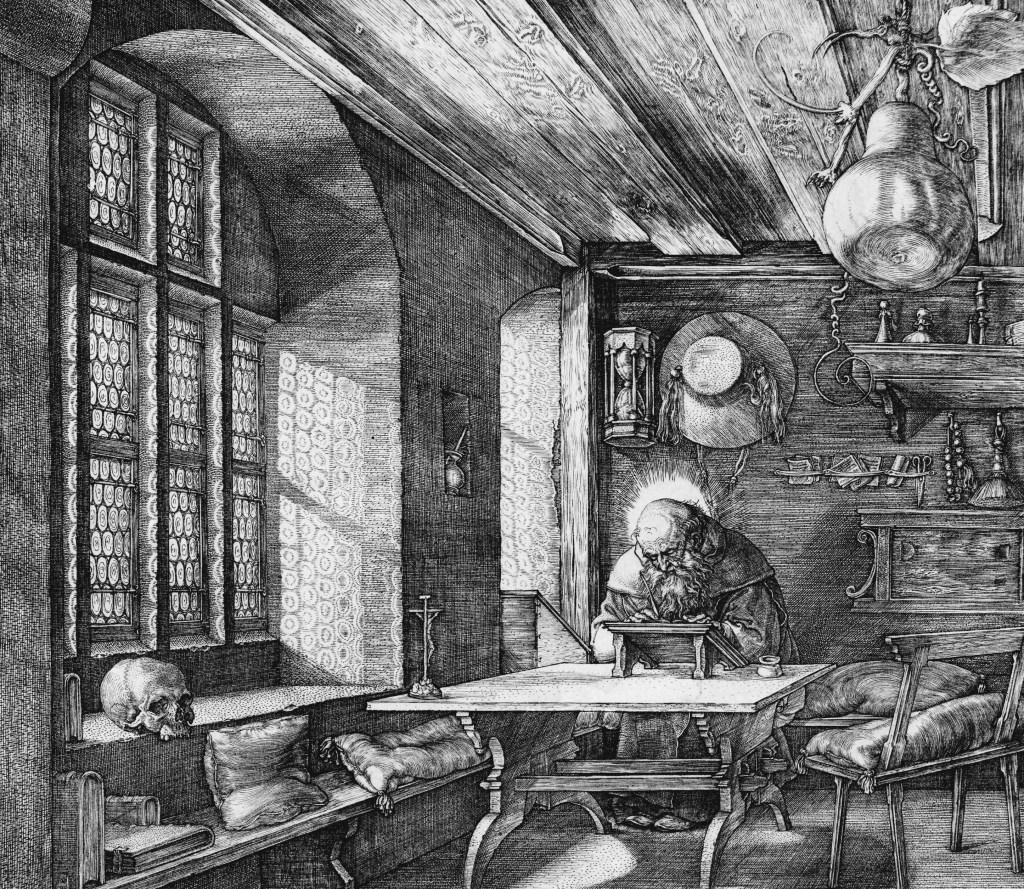
 Albrecht Dürer, St. Jerome in His Study (1514)

Do not be conformed to this world, but be transformed by the renewal of your mind, that by testing you may discern what is the will of God, what is good and acceptable and perfect.  

I

A common line of concern amongst Christians is that our faith become a matter of the mind alone. As we conceive of it, knowledge is of two kinds. There is ‘head’ knowledge, which is important and not to be sniffed at – this is the realm of the theoretical, the abstract, the doctrinal. But then there is ‘heart’ knowledge, the real marrow of Christian growth and learning, and what truly ought to be the aim of all our studies and sermon-hearing. Without the latter we make a mockery of the former. More than that, there is a sense in which head knowledge that fails to pierce the heart is worse than ignorance, for it leaves our waywardness without excuse. So Thomas Brooks, a fiery puritan even by the standards of that most fiery era of Church history, prefaced his famous Precious remedies against Satan’s devices (1652) with the following admonition to his readers:

‘If thy light and knowledge be not turn’d into practise, the more knowing man thou art, the more miserable man thou wilt be in the day of recompence; thy light and knowledge will more torment thee, then all the Devills in hell.’

Continue reading A mind renewed

The Holy Scriptures and the Divine Word

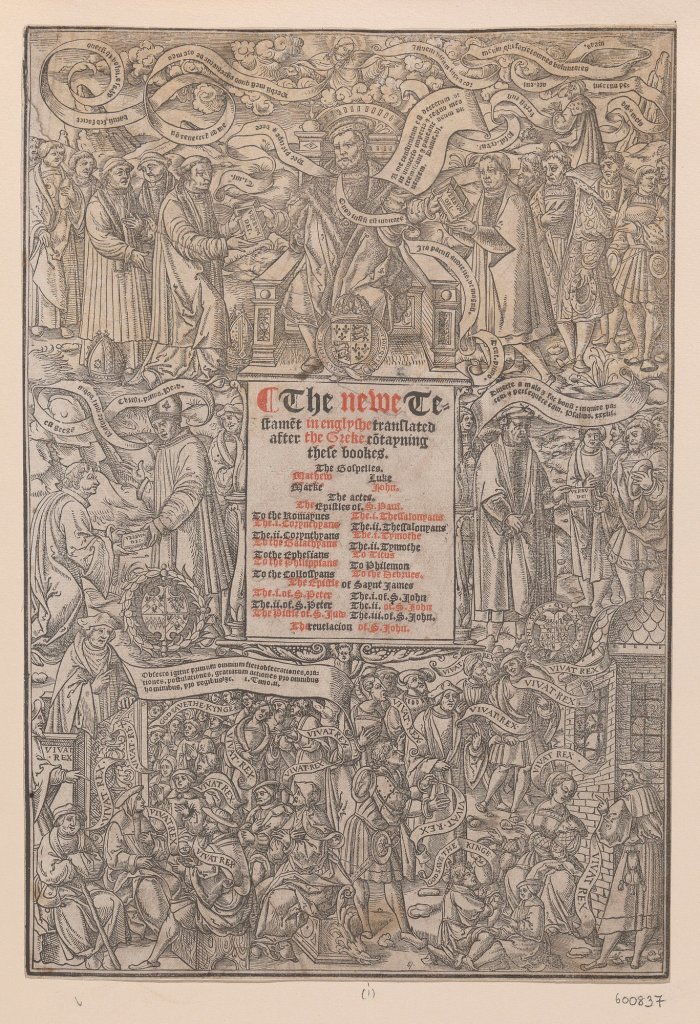
Frontispiece to the Great Bible of 1539

In the first instance, I do not believe that ‘God’s word’ means the Bible. I know that will outrage some, probably many, of my readers, and rightly so. For what makes those of us labelled ‘evangelicals’ distinctive within the wider sphere of those professing Christ is our conviction that the Bible, as God’s authoritative revelation, ought to be the highest authority in matters of faith and practice. As the Church of England’s Thirty-Nine Articles put it, ‘Holy Scripture containeth all things necessary to salvation’, such that ‘it is not lawful for the Church to ordain any thing that is contrary to God’s Word written’. That is so often the crux of the issue in the Church’s microcosms of the culture wars: by and large, those who confess the authority and divine character of the Scriptures sit on one side of the debate(s), and those who attenuate that authority on another. So we understand the importance of this doctrine, and we cherish it. Without the authority of Scripture, we fear doctrinal drift will be all too close at hand: into liberalism, papism, or apostasy. We are ever indebted to the Bible as the site of God’s revelation to us, and our guide in a seemingly guideless world: ‘Your word is a lamp to my feet, and a light to my path.’

Continue reading “The Holy Scriptures and the Divine Word”

God of the Nations

The Fourth Discourseman

One of the big problems facing evangelical churches in the West is a dearth of proper thinking about politics. Not that we have incorrect political theologies per se; it’s more that we lack any real political theologies in the first place. The reason for this is that we have too readily breathed the air of secularism that pervades our cultural climate – more than we know, and certainly more than we care to realise. And that is because secularism works, to a point. Or at least, it has worked, in the past; these days its unravelling seems unstoppable, as the ‘latent potentialities’ of the secular creed are at last reified into the new civic religions we see today, with all their antichristian tilt. Happily there is now a groundswell of discontent, but it has come too late. For too long we have gone along with secular liberalism, content that its ‘you do you’ approach to mutually incompatible beliefs and worldviews would allow the church to undertake its mission to the world in freedom and confidence. That it would tear apart societies seems not to have occurred to us.

Continue reading “God of the Nations”

On Mental Health

A critique of contemporary thought

I

It’s impossible to start an article of this kind without the token clichés. So I’ll keep them short. We all know, as we certainly can’t avoid being told, that today mental health problems abound. I’ve heard countless sermons that cite statistics indicating as much, and doubtless my readers have too. It’s been one of the big themes of the Covid-19 pandemic, of course. As a postgraduate student, my email inbox is full of constant reminders to ‘look after my mental wellbeing’, and that sort of thing. Seventy-five years ago this country won the war; now its elite institutions have ‘welfare puppies’ to help young people deal with the stress of exams. But it’s not all worthy of my cynicism. There was a danger in the late-Victorian invention of the stiff upper lip, some of whose force is mitigated by the greater openness in society today surrounding such matters. What that greater openness has revealed is that many people do indeed struggle with anxiety, depression, and the like, and that being able to talk about those things and find help is immeasurably better than suffering in silence and stigma. But is that all the picture?

Continue reading “On Mental Health”