Unpicking Fascism: A Response to The First Discourseman

The Second Discourseman

The First Discourseman recently wrote an article in which he sought to establish an understanding of fascism beyond its contemporary usage as a slur against right-wing politics. He did so successfully – too successfully, perhaps. As he unpicked fascism as being ‘concerned above all else with the nation state’, including the ‘creation of national myth’ and ‘admiration of great men’, I wondered whether progressive Internet warriors might be on the money after all.

Continue reading “Unpicking Fascism: A Response to The First Discourseman”


Wrong Rights

Okay but like – I’ll respect a conservative’s political beliefs when they respect trans people’s right to healthcare, poor people’s right to vote, asylum seeker’s right to safety, young people’s right to good mental health services and a decent standard of education, children’s right not to starve, disabled people’s right to marry without having their benefits cut, people’s right not to be subjected to police violence.

Some student on Facebook
Continue reading “Wrong Rights”

God of the Valley

The Fourth Discourseman

It’s a common experience in the Christian life to feel near to God when things are going well. I don’t mean well in a purely worldly sense; spiritual flourishing can ripen in the midst of great worldly pain, and sometimes misfortune even adds to that. There are moments when we know a profound sense of joy in the midst of anguish, when our suffering is sanctified by knowledge of God’s love for us, and his sovereign ordaining of all things for our good. The hope of future glory is woven into present pain.

Continue reading “God of the Valley”

The Unhelpful Taboo of Fascism

The First Discourseman

This isn’t meant to be clickbait, or an attempt to probe the boundaries of free speech and thought. Like most overused terms- particularly when they’re overused as an insult- definitions quickly become obscured and relegated to the side-lines, when they should be the starting point of discussion. ‘Fascist’ must be one of the internet’s favourite insults- almost synonymous with Hitler and with Nazism- but is also a regular rhetorical device of the progressive left (here’s Owen Jones asking whether Britain is ‘sliding into fascism’). One cannot hear the word fascist without thinking of anti-Semitism, vitriol, violence, perhaps evil in its most unadulterated form.

Continue reading “The Unhelpful Taboo of Fascism”

The Limits of Rationality

The First Discourseman

It seems every age claims enlightenment- in the eighteenth century The French Revolution considered itself the advent of a new rational era; in the early twentieth century the philosophy of logical positivism affirmed that the only type of knowledge was scientific; then at the end of the century the fall of the Berlin Wall ostensibly marked the beginning of a new political consensus of liberal democratic values. The prophets of rationalism constantly rise up- the Steven Pinkers and the Richard Dawkins’s, heralding the way to a new and better age where reason, truth, facts and logic will influence political systems, social interactions and ethical debates. If reason sits in its own realm, accessible by all who put their minds to it, everyone should reach the same conclusions eventually. It’s seen in the discussion around COVID too- for many, the decrees of the scientists are the final word on the matter since scientists possess an objectivity and perspicacity the general population lacks, as if there is no moral or prudential element to public policy.

Continue reading “The Limits of Rationality”

How thinking mathematically might help us all argue better

The Third Discourseman

‘Trans-women are women’ – this is a statement often spouted by people wanting to fight for transgender rights. For many in our day and age, its truth is not negotiable. It’s blindingly obvious, and even an attempt to debate it is backwards and outdated. Yet some remain who might want to deny it- in fact a reasonably broad range of people from TERFs (trans exclusionary radical feminists) to social conservatives and many religious groups. And disagreements over a statement like this one at best cause outrage, offense and argument, and at worse could leave you ‘cancelled’ and out of a job.

Continue reading “How thinking mathematically might help us all argue better”

Good works are good

The Fourth Discourseman

Why should we do good works? There’s a way of telling the gospel that makes this a normative question, perhaps even a virtuous question. The logic goes like this. I am a sinner, and the consequence of my sin is God’s righteous judgment. But God has, graciously, provided a way to deal with the consequences of my sin by sending Jesus to die in my place. He pays the price that I should have to pay for my rejection of God, winning for me pardon for my sins. I need only receive this as a gift, given freely, and grasped by faith alone.

Continue reading “Good works are good”

Lessons from early-modern atheism

The Fourth Discourseman

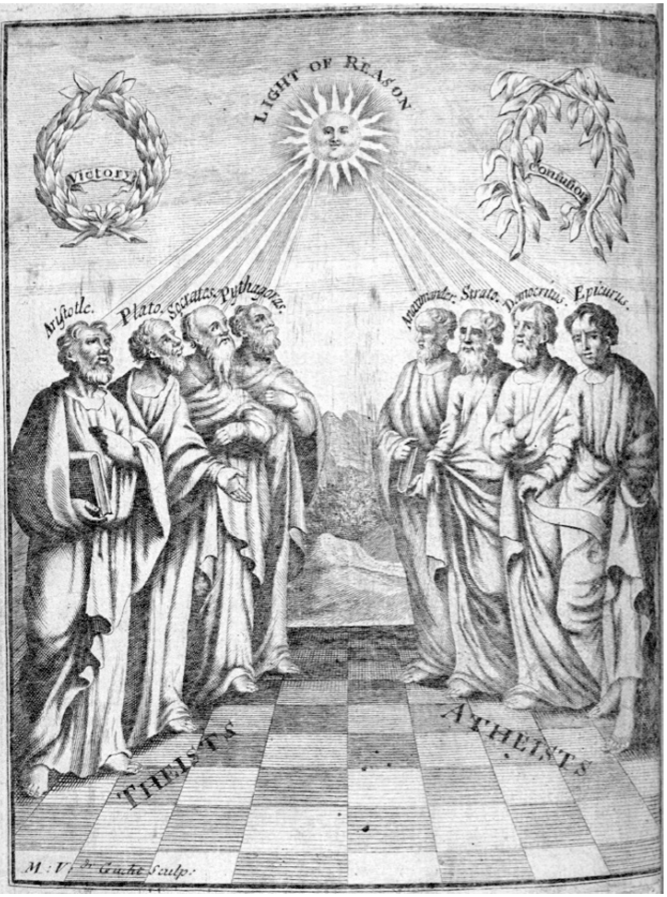
Frontispiece, T. Wise, (ed.), A Confutation of the Reason and Philosophy of Atheism (London, 1706).

It’s something of a truism to observe that today belief in God is less ubiquitous than it was in past incarnations of our society. I could cite Pew Centre research that seems to show the decline of religion in the United States, or similar data for European countries; but the main point is that atheism has ceased to be a radical, beyond-the-pale belief system, and is instead one of a growing plurality of acceptable creeds one can comfortably subscribe to. That, at least, is one essential part of secular modernity, to which so many western countries adhere. Leaving aside my own belief (following C.S. Lewis, Fyodor Dostoevsky, and more recently, Jordan Peterson) that no one is really an atheist – that we all worship some transcendent Other, however atheistically we might attempt to construe that – this nonetheless represents a significant shift in the fabric of society and our collective moral universe.

Continue reading “Lessons from early-modern atheism”

Don’t Love Everyone

And rising very early in the morning, while it was still dark, he departed and went out to a desolate place, and there he prayed. And Simon and those who were with him searched for him, and they found him and said to him, “Everyone is looking for you.” And he said to them, “Let us go on to the next towns, that I may preach there also, for that is why I came out.” And he went throughout all Galilee, preaching in their synagogues and casting out demons.

Mark 1:35-39
Continue reading “Don’t Love Everyone”