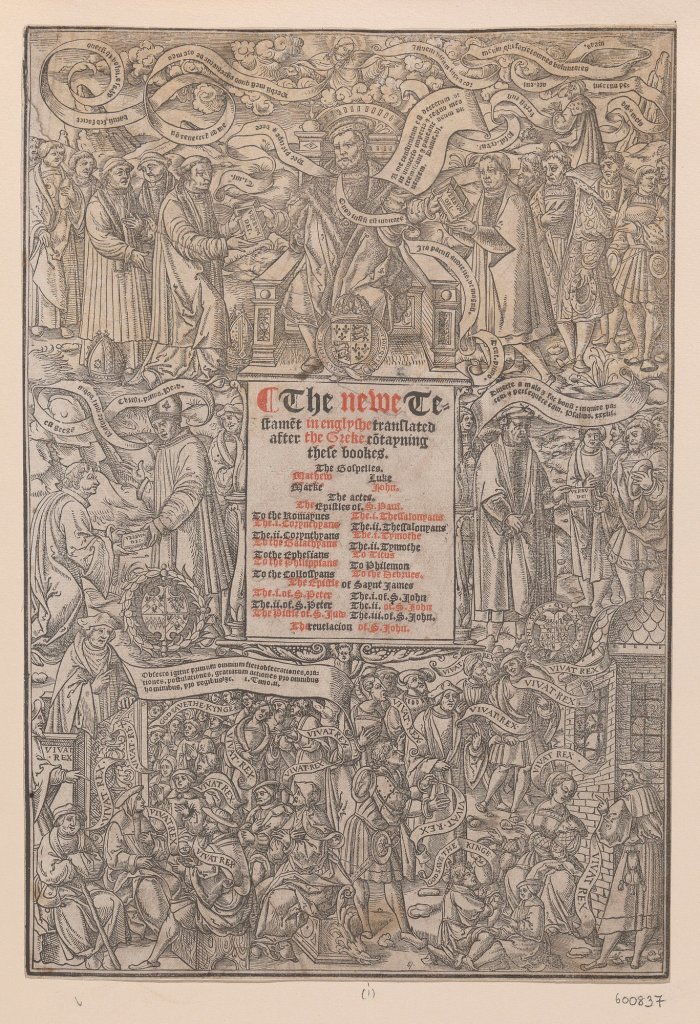
In the first instance, I do not believe that ‘God’s word’ means the Bible. I know that will outrage some, probably many, of my readers, and rightly so. For what makes those of us labelled ‘evangelicals’ distinctive within the wider sphere of those professing Christ is our conviction that the Bible, as God’s authoritative revelation, ought to be the highest authority in matters of faith and practice. As the Church of England’s Thirty-Nine Articles put it, ‘Holy Scripture containeth all things necessary to salvation’, such that ‘it is not lawful for the Church to ordain any thing that is contrary to God’s Word written’. That is so often the crux of the issue in the Church’s microcosms of the culture wars: by and large, those who confess the authority and divine character of the Scriptures sit on one side of the debate(s), and those who attenuate that authority on another. So we understand the importance of this doctrine, and we cherish it. Without the authority of Scripture, we fear doctrinal drift will be all too close at hand: into liberalism, papism, or apostasy. We are ever indebted to the Bible as the site of God’s revelation to us, and our guide in a seemingly guideless world: ‘Your word is a lamp to my feet, and a light to my path.’
So let me explain myself. I would do better, it seems, to state the issue positively: I believe that the Holy Scriptures, the canon of the Old and New Testaments, are the authoritative, God-given, divinely-inspired, infallible and inerrant revelation of the truths of God. That, I hope, is a confession my readers can rally around. But to the attentive among them it ought to be apparent that this in no way contradicts my opening salvo. My emphasis is on Scripture as the site of revelation of God’s truth. In other words, Scripture speaks God’s word, but is not itself primarily God’s word.
This isn’t a new idea. As I indicate below, it is thoroughly Augustinian. And it isn’t foreign to the Reformed tradition; indeed, it’s there in the Westminster standards. The second question of the Shorter Catechism goes like this:
Q. What rule hath God given to direct us how we may glorify and enjoy him?
A. The Word of God, which is contained in the Scriptures of the Old and New Testaments, is the only rule to direct us how we may glorify and enjoy him.
That wording is important: the word of God is contained in the Scriptures. To say as much today is essentially to undermine the Bible’s authority; if I said that the Scriptures contain God’s word, then you’d probably assume that by implication I didn’t believe the whole Scriptures to be God’s word, for if I did, I would simply say that the Scriptures are God’s word. That was, incidentally, the opinion of the puritan minister Richard Baxter; it was his go-to argument whenever someone raised apparent contradictions in the text of Scripture. But it most certainly was not the opinion of the Westminster Divines. For them, the whole of Scripture authoritatively contains the word of God. But it does indeed contain it; Scripture is not, in the first instance, to be understood as commensurate with the word of God, which is rather the doctrine revealed therein.
At this point it might occur to my readers: can we not use the phrase ‘the word of God’ equivocally? That might well be what is going on when people refer to the Bible in such terms. By calling the Bible ‘the word of God’, they would say, they are not denying that it simultaneously points to ‘the word of God’, understood to mean the teaching and doctrine revealed in the Scriptures. These are just two different uses of the phrase, just as when we refer to Christ as ‘the word of God’ we are not denying that the gospel message ought also to be spoken of in such terms.
Before continuing, I want to answer this objection with two observations. Firstly, equivocation is not helpful, and ought only to be permissible when found in Scripture itself – as in the Christ/doctrine distinction in the use of this phrase. Secondly, ‘the word of God’ is rarely used to mean the message of the gospel, which, as I argue below, is the primary use of the phrase in Scripture itself. I believe that this disjunction between the language of Scripture and our own terminology has arisen from an emphasis on the Bible as the word of God at the cost of seeing the Christian doctrine revealed in Scripture as the word of God.
In general, then, I believe it best to distinguish between ‘the word of God’ – the doctrine contained in Scripture – and Scripture itself, which authoritatively reveals that doctrine. There are two reasons I am keen to make this distinction. The first is biblical, or exegetical, and the second is philosophical.
(1) The ‘word of God’ is not a phrase Scripture uses, to the best of my knowledge, in describing Scripture. Growing up in the evangelical church, I learnt various memory verses, often put to somewhat banal tunes, about the Bible (or so I was told). There is Hebrews 4:12: ‘For the word of God is living and active, sharper than any two-edged sword’, which was understood fairly straightforwardly as meaning that the Bible is not a dead text but a living one, able to change lives upon Spirit-animated reading. Then there is 2 Timothy 2:15, which teaches that a church elder ought to be someone able to correctly handle ‘the word of truth’ – as clear a defence of contemporary exegetical preaching that you’re likely to find, if The Proclamation Bible is to be believed. The same goes for 2 Timothy 4:2, where ‘preach the word’ is taken to mean ‘explain the meaning of biblical texts’. And for a whole host of other texts, like Acts 20:27, where ‘the whole counsel of God’ is simply taken to mean the canon of Scripture; or Acts 8:4, 15:35 – the list goes on.
In other words, in all these readings ‘the word’ is taken to mean the Bible. But I see no exegetical justification for this. In the first place, the Bible didn’t exist then, and in none of these examples is ‘the word’ that is preached intended to mean the Old Testament, since it is clearly the message concerning Christ, which while foreshadowed in the Scriptures before his coming was not clearly made manifest until he came as Prophet, Priest and King; hence the prophets of old saw but dimly into that which is revealed in the New Covenant (1 Peter 1:10–12). When the Old Testament is intended, it seems to be referred to as ‘Scriptures’, as in 2 Timothy 3:15–16 or Romans 15:4, not as the ‘word of God’. It seems, then, that when the New Testament writings speak of ‘the word of God’, they are referring to the message of the gospel. In other words, this is about doctrine, truths that are proclaimed by apostles and pastors.
Before I get on to why this is important, it is worth making the philosophical point that I promised above. And that is that (2) we must always make a careful distinction between text and message, words and things. This is not a popular point after the era of the linguistic turn, but it is essential if we are to believe – as we must – that ideas and truth claims can transcend linguistic contexts sufficiently as to enable twenty-first-century moderns to understand age-old writings from the ancient near east. And it is a very catholic point, too; St Augustine’s sharp distinction between words and things informed western biblical exegesis for centuries. I myself sit somewhere between the insights of twentieth-century linguistic philosophy and the time-tested hermeneutic of Augustine, if such a position is tenable. I believe that words themselves shape meanings, such that perfect synonyms do not actually exist; but that ‘things’, which exist beyond the realm of words, are incarnate in those specific words which are never truly synonymous. I’ve chosen the word ‘incarnate’ carefully, since analogy to Christ is helpful; if Christ had been incarnate in a different body, he would have in some sense been a different man, yet in another sense the same, since his substance as the divine logos would be unchanged. So it is with words and things.
Words are important, then, since they shape meaning profoundly. They provide localised incarnations of eternal ideas, and that is not to be overlooked. (It is why I don’t read poetry in translation, with the odd exception.) But those eternal truths are the marrow of our dealings with language, and should be the focus of our concern. This is one reason for my emphasis on Scripture not as the word in itself but as the revelation of the word. The weight ought to be upon the reality behind the text itself, a point made repeatedly by John Piper (throughout his myriad writings, but especially in Reading the Bible Supernaturally) and, to a lesser extent, by John Stott (in Christ the Controversialist).
Why is this important? One easy answer is the simple exegetical point, that we ought not to twist the words of Scripture. It simply is not the case that Hebrew 4:12 and other similar texts are referring to the Scriptures, in their literal sense. I have no problem with a hermeneutic that applies such texts to Scripture by way of careful reasoning, as long as I am not being asked to believe that the original author’s intent (not an exegetical move I like relying on too much, but that’s an issue for another time) was to say as much, which is simply untrue. This isn’t an issue of mere pedantry, since belief in the authority of the Scriptures is, as I discussed above, essential. To base such belief upon the misreading of certain biblical texts is to build on shaky foundations indeed, foundations that will not outlast the clear reasoning of an opposing view. And that is a dangerous place to be.
More fundamental, however, is the simple fact that doctrine matters. There is a danger in our emphasis on the Bible as God’s word that our focus becomes taken up wholly with the text itself, to the exclusion of the dogmas which it authoritatively reveals. The consequences of this are serious. In the first place, it can leave Christians with an incoherent message. If the text itself is our telos of understanding, rather than the reality behind the text, then we are less inclined to establish exactly how it all fits together. That is particularly the case with the Bible, given its multifarious and varied character – in terms of genre, doctrinal emphasis, linguistic attributes, and the like. The books of Scripture are akin to windows, each giving insight into God’s revelation. Each bring a new perspective, but they all point to the same coherent, holistic message. But if the windows are our primary concern, the coherence of their shared revelation need not be found in quite the same way as when the content of that revelation itself is our primary concern. That is why, in evangelical churches that emphasise biblicism and expository preaching over doctrine and systematics (not that they are mutually exclusive), sermons and bible studies can sometimes slip into that strange hermeneutic of pretending that the particular book or epistle under scrutiny is, for the duration of our studying it, the only revelation of God. So when we read Paul we teach salvation by faith alone, and when reading James, salvation by faith and works; or we forget when Christ is Priest (as we read Hebrews) that he is also Prophet and King.
Much has been regained in the revival of exegetical preaching since the 1950s and 60s. (I say ‘revival’, but it is of course more historically-situated than that.) But though the average layperson might be able to explain books of the Bible better, can they explain basic Christian doctrine better than our forebears? How many in our congregations would be able to give a clear answer to that most fundamental of catechetical questions, What is God? But in bygone times, before the biblicism of our own day took root, such doctrinal understanding was taken for granted. (A deeper knowledge of the Bible was taken for granted, too, which suggests that the apparent animosity between the biblicist and the doctrinal approaches is less substantial than we tend to believe.) It is greatly to our detriment that we have lost such an approach. There are of course many reasons for this; but the biblicist approach that emphasises the text of Scripture as the word of God, rather than being the authoritative revelation of the word of God, is in part to blame. Let us scour the text, let us exposit it to the best of our ability; but let us not stop there, when the fruits of robust doctrine are but a step away from such labours.
Secondly, emphasis on the words of Scripture as the word of God is one ingredient for an approach to Scripture and Christian doctrine that I call ‘biblical positivism’. I have hinted at this in previous writings, and I hope to write about it more fully elsewhere, but a brief summary will suffice at this juncture. In essence, biblical positivism is the belief that what the Bible says is true because the Bible says it. Biblical doctrine is simply laid down – posited – by Scripture. In this view, the Bible has what amounts to generative power with respect to truth, the power to create dogmas. The reality, of course, is wholly different; what the Bible says is not true because the Bible says it, but rather, the Bible says its because it is true. The truths revealed by Scripture are true irrespective of Scripture – true before the giving of the canon, true even if it had never been given. We simply know them to be true because of Scripture’s authoritative revelation.
Of course, people never put biblical positivism in the stark terms that I have, as a claim that the Bible has ontological rather than merely epistemological authority. The shift into this way of thinking is much more subtle. Often, it begins with a separation of the spiritual from the physical, temporal, or earthly; a move which, as I have written elsewhere, is predicated on a kind of secular dualism. The Bible becomes a separate realm of revelation to that of, for instance, the world, human learning, nature, etc.; and in the end these two realms become so distinct as to be essentially contradictory. We cease to believe that what the Bible reveals to be true also inheres in reality itself. And this has led to much confusion, notably in the realm of sexual ethics. Like I say, I hope to revisit this more fully at a later point. But if Christians are to be effective witnesses in an increasingly hostile world, and if our positions are to have coherence both to ourselves and to outside observers, then we need to recover an understanding of the essential unity of all revelation, and we need to reject, emphatically, an understanding of biblical doctrine that is positivistic. Christian truth is revealed in Scripture; but it already and has always existed, and it inheres in reality itself irrespective of that all-important revelation.
I love the Bible, and I hope my readers do too. But I love it not for itself, however beautiful much of it may be, considered from a purely literary perspective. No, I love it because of what it reveals to me: true reality, the truths of God. Without that I am blind, indeed, we the church are blind; and in this sense the Scriptures are an immeasurably precious gift to us. But if by ‘the word of God’ we primarily mean the text of Scripture, then we are missing the point. Down this path we can end up, all too easily, resting in mere exegesis and exposition, when life-changing and robust doctrines are there for the taking. But I am convinced that the Church today needs precisely that foundation of robust doctrine that a purely biblicist approach falls short of. Let us embrace, then, the word of God: those dogmas and truths which have come to us, straight from the heart of reality, by the authoritative revelation of the Scriptures.
The Fourth Discourseman
 The Four Discoursemen
Nice. I find the distinctions you can make in Greek helpful – logos, graphe, and rema – that is the Word (i.e. Jesus), the written word, and the message, (i.e. the content of the written word, and the words Jesus speaks, what it is actually informing you of/telling you to do).
Only using the word ‘word’ flattens some of this, and we forget the relationship between text and referent.
LikeLike