The Second Discourseman
The day Thou gavest, Lord, is ended,
The darkness falls at Thy behest;
To Thee our morning hymns ascended,
Thy praise shall sanctify our rest.
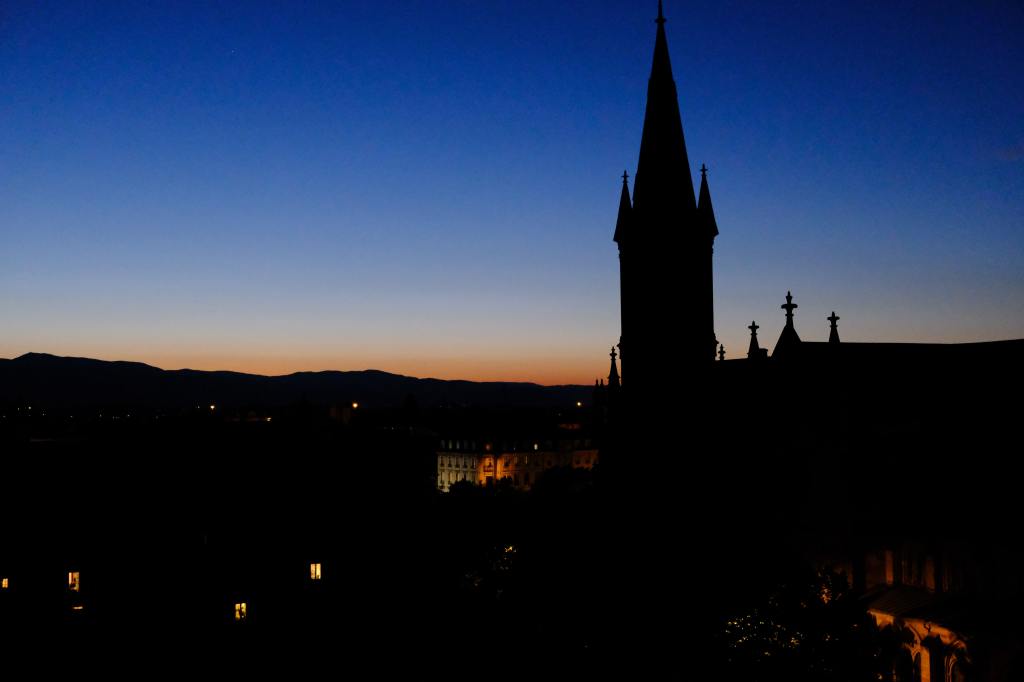
It is hard to pin down the feeling as I leave church into the Sunday evening’s darkness; a feeling which, though it presumably has its counterpart in all working folk, can only reach its full dimensions in those who have come from meeting in the presence of the Divine. It need not be so much as sadness or worry, for the week ahead may hold no particular gloom. It is not loss, since Sundays come as often as they go and their finiteness is not usually obvious. I think it can only be described as it is, which is the stepping from light into twilight, from beholding our God to facing earthly life once more. It is the fundamental human experience of night coming.
Of course, no small element of this is the end of our day of rest and the prospect of a week’s work. This is not a trivial concern, but in general we know the goodness and necessity of work, and we understand and are able to confront its fallenness. But the Sabbath rest is not merely an absence of work; it is also the act of dwelling in God. The weekly close of such a rest poses a deeper question. How can we turn from a day of consciously abiding in and worshipping Him, to something less than that? In John Ellerton’s hymn, The day Thou gavest, Lord, is ended, we see a beautiful example of a man deeply concerned with the glory of God answering this question.
We have not sung the first line before we have a full and sufficient answer: the Lord’s Day is a gift from God, and it is His to begin and to conclude as He desires. This is the final response to all experiences of darkness, being absences of the light given to us by God, that He has made ‘the day of prosperity’ as well as ‘the day of adversity’ [1]. In Ecclesiastes, the Preacher’s mystifying application is to not be ‘overly righteous’; perhaps a reminder that the times allotted for us to worship God as we desire come and go, and to strain against this may destroy ourselves. I cannot meet with fellow believers every hour of the week; I cannot pray while I sleep. Certainly, I could meet with believers more than I do, and I must pray more! but still there exist the limitations of our humanity.
But this does not mean that on a Monday morning we should be content, or even resigned, to cease fearing and loving God; indeed, neither should we feel this way as we lie down to sleep on the Sunday evening. For the blessings of dwelling in God are not just for the present: ‘if you faithfully obey the voice of the LORD your God… blessed shall you be when you come in, and blessed shall you be when you go out’ [2]. Our morning hymns offered up to God will, by His Spirit’s transforming power, echo in our hearts and minds, so that we praise Him even while our tongues are silent, even when we go out of church and come into the workplace. This is not some magical happening; it requires us to be continually faithful and sincere. Neither is it our doing, as if we are storing up favour with God by singing hymns each Sunday; it is God’s praise which ‘shall sanctify our rest’. It is His goodness, the mere acknowledgement of which kindles our daily drudgery into holy habitation.
A further Sunday blessing is the fellowship we enjoy as we worship together, but even this does not depart fully with the evening light. The theme which comes to dominate Ellerton’s hymn is the worldwide witness of the church:
The sun that bids us rest is waking
Thy children ‘neath the western sky,
And hour by hour fresh lips are making
Thy wondrous doings heard on high.
The worship of God is not a private enterprise which we instigate, and which wanes with our attentiveness. It is ordered by God Himself in creation and redemption, and as long as His church stands, ‘the strain of praise’ never dies away; indeed, we may say that our praise never dies away. Even while I sleep, I am a member of the praying, singing, serving church. The very rolling of the spheres amplifies the glory of their Creator, bringing morning adoration while elsewhere saints take their rest.
This orchestra of love expands into eternity as well as around the globe. God has given his Son a throne which ‘shall never, like earth’s proud empires, pass away’. There shall be no close of worship in this everlasting Sabbath city, for there will be no sun to set; rather, ‘the glory of God gives it light, and its lamp is the Lamb’ [3]. And so when night falls we need not despair or rage against it. May we instead let the goodness of the Father echo in our minds, the fellowship of the Holy Spirit bind our hearts together, and the undimming glory of the risen Lord be set before our eyes.
[1] Ecclesiastes 7:14-18
[2] Deuteronomy 28:1-6
[3] Revelation 21:23
 The Four Discoursemen
Thank you for this: a really thoughtful and encouraging article!
LikeLike
Thank you, that’s very kind!
LikeLike